Most floor mirror complaints are not about the mirror. They're about the box. A 160cm pane is the largest single piece of glass most consumers will ever own, and it travels by ocean freight, courier network and last-mile van before it leans against a bedroom wall. Packaging is where the category's margin is won or lost — long before anyone discusses frame finishes.
This guide covers the pack itself: the layers that survive transit, what a drop-test claim should mean, the damage-rate math that belongs in your quote, and the FBA constraints that reshape the carton.
The four-layer pack that survives ocean freight
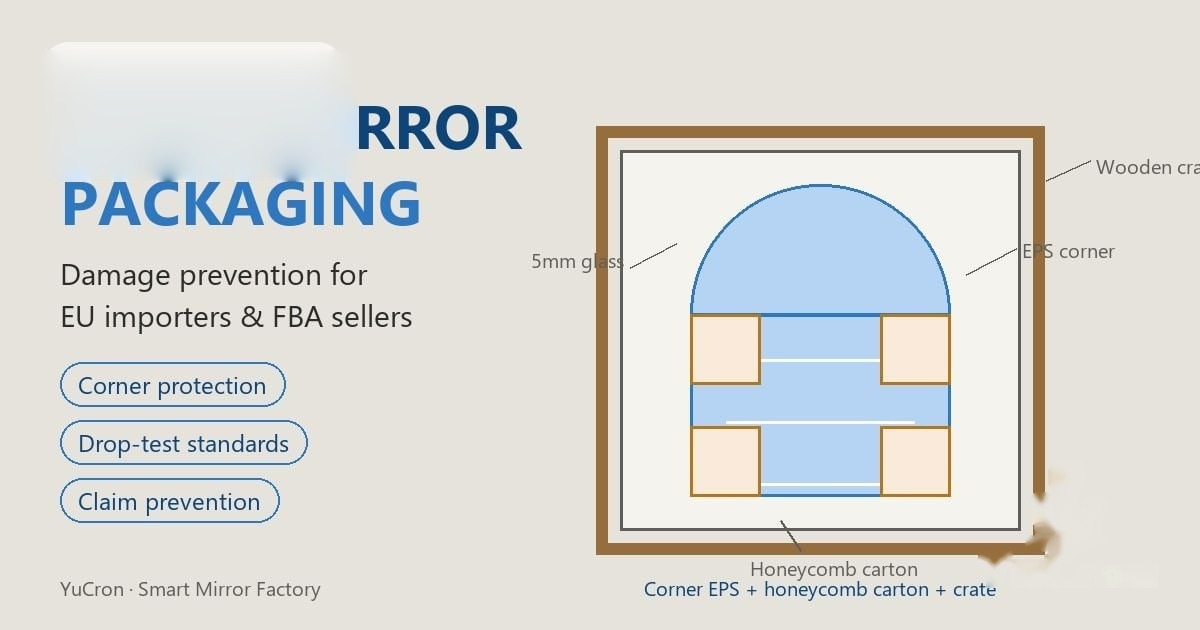
Ask any mirror factory for "export packaging" and you'll get a vague answer. A professional pack has four distinct layers, and each one answers a different failure mode:
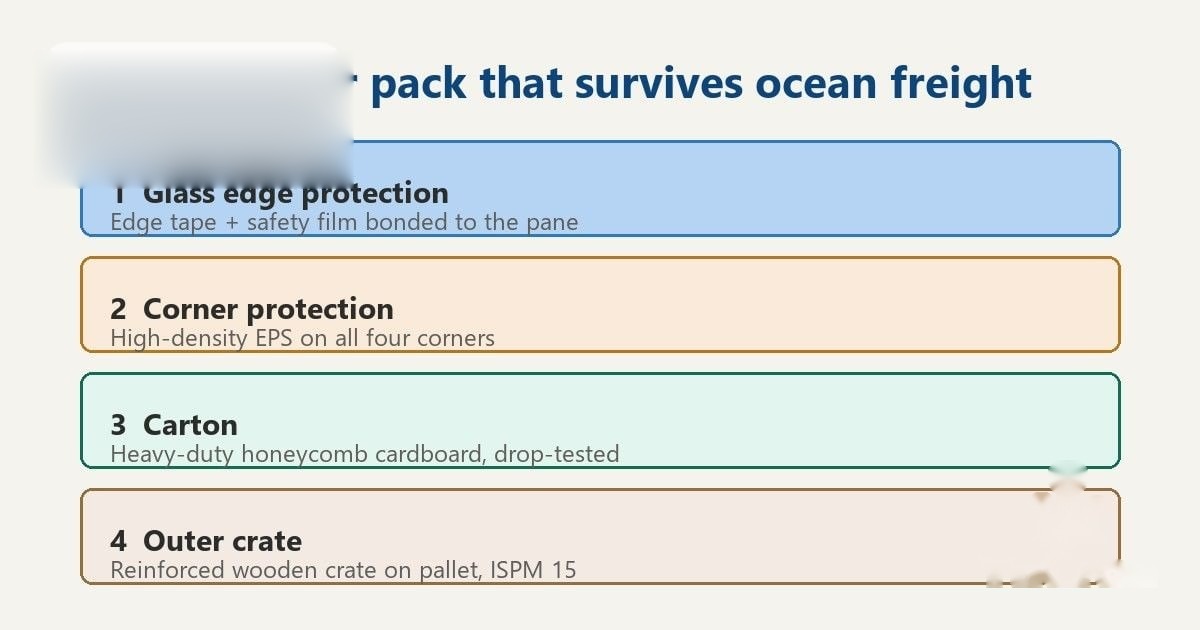
- Edge and surface protection. Edge tape on the glass perimeter plus a shatter-resistant safety film bonded to the back. The film is what turns a broken pane from an injury event into a replacement. EN 12600 classifies glass by impact behaviour; a supplier who knows their class has run the test.
- Corner protection. High-density EPS foam on all four corners — the points that take every drop, tip and pallet-stack impact. Ski corners are where cartons fail.
- Carton. Heavy-duty honeycomb cardboard, sized so the pane cannot shift. Double-wall board for anything over 150cm. The carton is a shock absorber, not a label holder.
- Outer crate. Reinforced wooden crate on a pallet for LCL and ocean freight, treated to ISPM 15 so customs doesn't reject it at the EU border. Air freight and full-container loads can sometimes skip the crate — the carton carries the load instead.
The layers stack in cost. A buyer who compares two quotes on mirror price alone is comparing the pack nobody described.
What "drop-tested" should actually mean
Every factory claims drop-testing. Few can answer the follow-up questions. A credible claim names the standard and the result:
- ISTA 3A simulates parcel delivery — the relevant test for courier and FBA shipments under about 70kg. Ask for the report, the drop height and the sequence used.
- ISTA 1A/2A cover basic shock and vibration — useful context, but they don't simulate a van ride.
- In-house corner-drop and rotational-edge tests are worth asking about even when no formal report exists; the answer tells you how the factory thinks about failure.
One practical check: ask what changed on the line after the last failed test. A factory that iterates on packaging is a factory that will still be shipping intact units in year two.
The damage-rate math that belongs in your quote
Breakage is not bad luck; it's a rate. And a rate belongs in the commercial conversation, not the claims department:
- A 2% damage rate on a €45 mirror adds about €0.90 to every unit sold. On a 1,000-unit order that's roughly €900 — usually more than the entire packaging upgrade would have cost.
- Returns logistics for oversized glass routinely cost more than the replacement unit. A broken mirror is not just a lost sale; it's a lost sale plus freight plus handling plus a one-star review.
- Insurance and carrier liability have exclusions for inadequate packaging. "Inadequate" is defined by what a competent pack would have looked like — the four layers above are the benchmark a claims assessor will use.
Ask suppliers for their audited damage rate by destination, not a verbal reassurance. A factory that tracks it can quote it.
FBA specifics: where the carton reshapes the margin
Amazon sellers carry constraints a wholesale importer never sees:
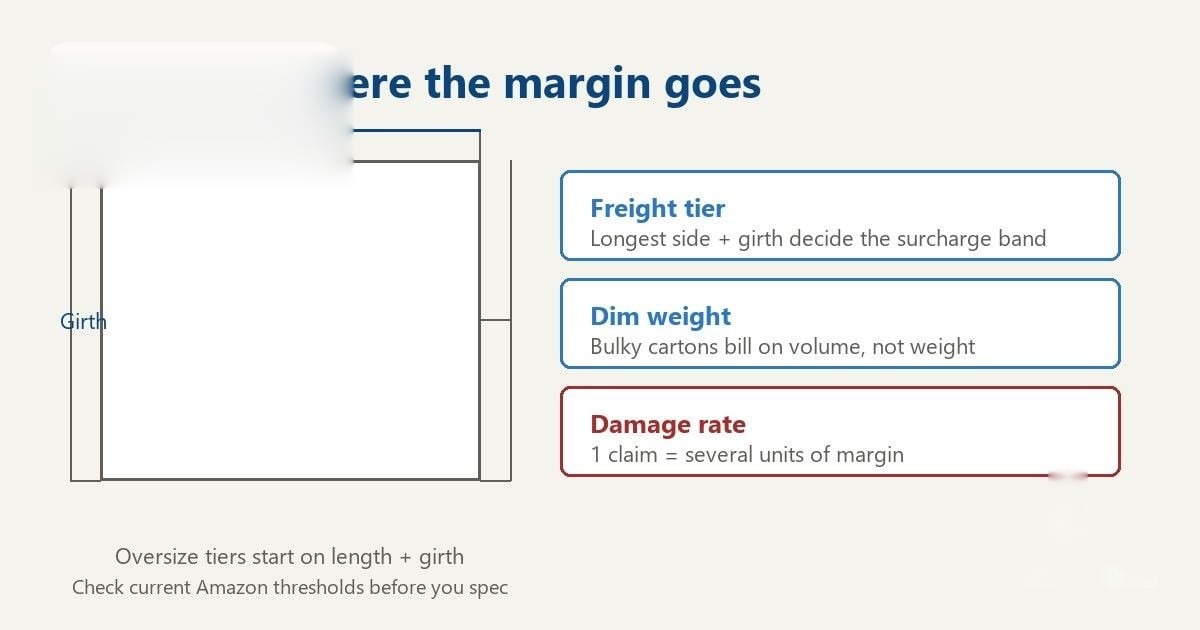
- Oversize tiers. A 160cm carton almost always lands in an oversize tier. Length plus girth sets the band — check current Amazon thresholds before finalising the pack, because a tier change can move fees by more than the mirror's margin.
- Dimensional weight. Bulky, light cartons bill on volume. Flattening the pack where structurally possible is free margin.
- Prep requirements. FBA has its own labelling and prep rules for oversized and fragile items; the carton must arrive ready for the FC, not ready for a shop shelf.
- Damage at the FC. Mirrors that survive 40 days at sea still break on a conveyor. Corner protection and a shift-proof interior matter more here than anywhere else in the chain.
For the buying-side view — channel economics, factory vs trading company — the factory-direct sourcing guide runs the numbers.
Retail packaging and the unboxing moment
For DTC and Amazon buyers the carton is part of the product. A pane that arrives through a crushed box with a torn label reads as damaged even when it isn't. Print quality, a clean open-top design and an instruction card that shows the anti-tip fixings — these cost cents and decide the review score. Wholesale accounts shipping to retail shelves need the opposite: plain, stackable, barcode-ready.
Sizes, Glass and Frames: The Spec Behind the Pack
The pack is built around the product, so three product decisions come before any packaging quote. Height sets the carton tier: 150cm parcels cheaply but reads as a half measure in continental markets; 160–170cm is the volume band for Europe and the Gulf; 180cm delivers the strongest statement piece but pays oversized dimensional weight. Glass decides fragility: 5mm copper-free HD silver glass resists the black-edge corrosion that humid bathrooms and coastal climates cause, and the shatter-proof safety film doubles as the packaging's first line of defence — a filmed pane that breaks stays in one piece. Frame decides weight and corner stress: slim aluminum is light and stable; solid wood and brass finishes add weight that the EPS corners and crate must carry. Quote all three before the pack, and the packaging cost stops being a surprise.
OEM/ODM: When the Carton Becomes the Brand
For DTC and private-label programs, the carton is the first physical contact a customer has with the brand. OEM/ODM factories can print your logo, match the box finish to your identity, print the instruction card with your anti-tip guidance and reserve tooling exclusively to your brand — turning a commodity pane into a branded unboxing moment. The full customization roadmap — finishes, smart upgrades, pre-shipment inspection — is covered in our private-label OEM/ODM guide. The packaging layer is where most programs start, because it is the cheapest place to look branded while the mirror itself remains a stock build.
What to put in your RFQ
Send this instead of "price for floor mirror":
- Target carton dimensions and whether air, LCL or FCL applies.
- Destination markets and the last-mile channel (retail shelf, courier, or FC).
- Required pack layers, and whether a crate is included in the quoted price.
- The damage rate the supplier will stand behind, in writing.
- For LED versions, the certification stack — the EU, US & Middle East compliance guide lists the files per market.
The floor mirror wholesale guide covers the spec side; the full-length mirror size guide covers heights and formats.
Request a Quote → Send your carton targets and destination markets, and we'll come back with the pack spec, the layer costing and the damage rate in writing — not adjectives.
The Documents That Name the Glass and the Carton
Packaging claims hold only when a standard sits behind them. The impact-test classes used for safety-backed mirror glass in the US are published in 16 CFR 1201; the US Consumer Product Safety Commission keeps the public recall and incident record that shows what failed packaging looks like after the fact; and the carton rules Amazon publishes per marketplace decide whether a "survives freight" claim means anything at inbound (seller requirements).
| Journey leg | Failure mode | Spec that prevents it |
|---|---|---|
| Ocean freight | Container humidity, stack crush | Corner posts + moisture barrier |
| Courier network | Drop and shock | Documented carton drop-test protocol |
| FBA inbound | Carton rejection | Marketplace oversize-carton rules |
| Customer doorstep | Edge chips | Full-perimeter EPE inside the box |
The Range This Factory Actually Stocks
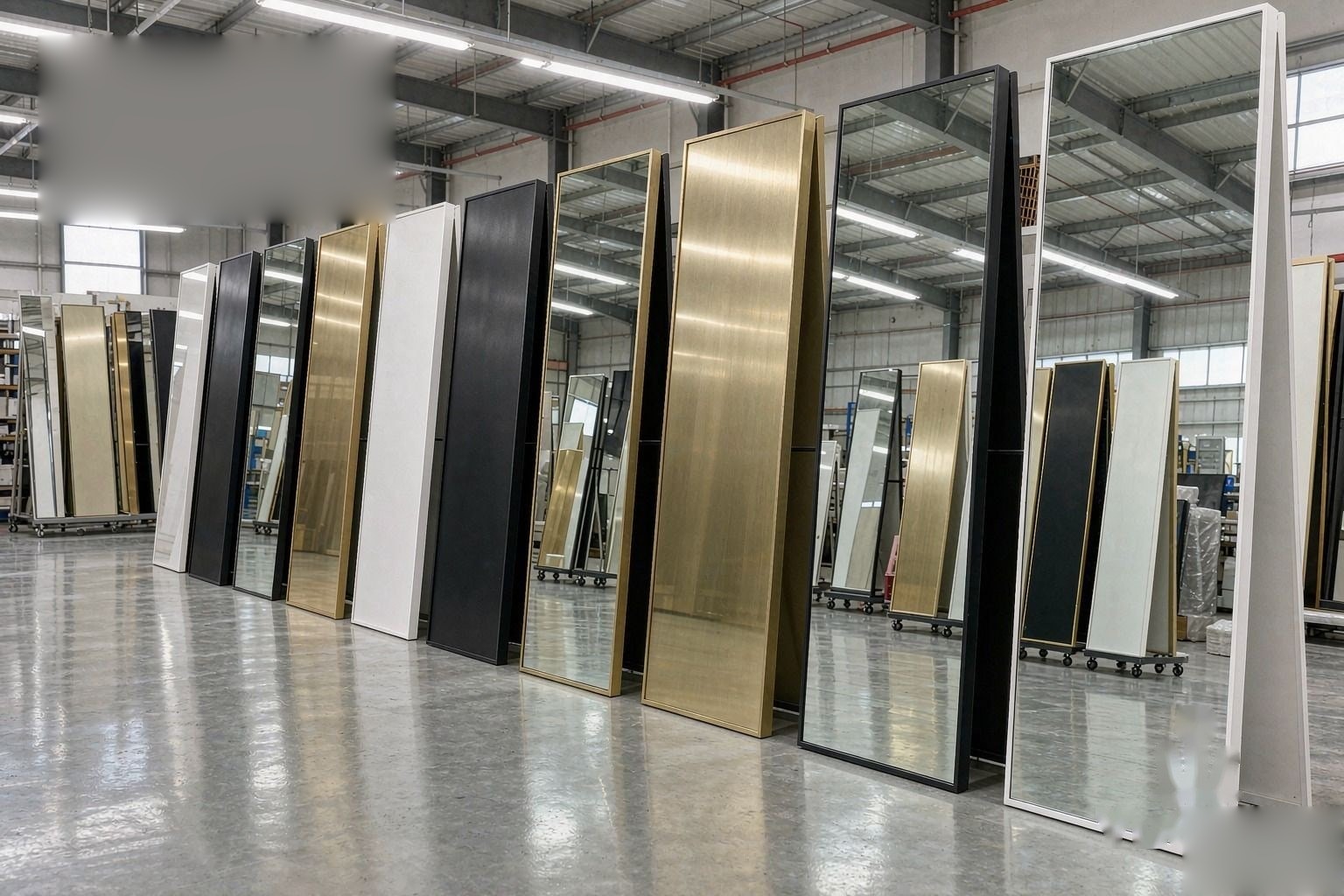
The full length mirrors wholesale line — 15 stock formats, 40×150 to 200×100 cm — is the stock ladder this guide refers to; the page carries the current finishes and sizes per model.
FAQ
Q: What is the minimum packaging for a floor mirror shipped by sea?
A: Edge protection, safety film, four EPS corners, a double-wall honeycomb carton, and a pallet. Crates are added for LCL or when the destination requires ISPM 15 treated wood.
Q: Does the safety film really prevent injuries?
A: It holds fragments together on impact, which is why European buyers and marketplaces treat it as table stakes for full-length formats. It doesn't make the glass unbreakable — it changes what happens when it breaks.
Q: How do I compare two quotes where one includes a wooden crate?
A: Normalise the pack first. Price the crate separately, then compare mirrors on identical pack specs. A quote without a crate is not cheaper; it's a different product.
Q: What damage rate should I plan for?
A: Ask the supplier for their audited rate by route, then build your own buffer on top. Plan the claim process before the first container, not after.
Q: Can FBA shipments skip the wooden crate?
A: Usually yes — air and courier packs run carton-only. Keep the corners, the film and the shift-proof interior; the crate exists for ocean and LCL handling, not the FC.
Q: Does a private-label carton change the packaging cost?
A: Yes, modestly. Logo printing, branded instruction cards and matched box finishes add cents per unit but materially lift the unboxing review score for DTC and Amazon sellers. The structural layers — EPS corners, film, honeycomb board — stay identical; only the print layer changes.
Q: How does humidity affect tall mirror shipments?
A: Moisture inside a sealed carton can fog the film or corrode frame edges on long sea routes. Professional packs include desiccant sachets for Gulf and tropical destinations, and the wooden crate is treated to ISPM 15 so the whole unit survives customs inspection and the humidity of the voyage.