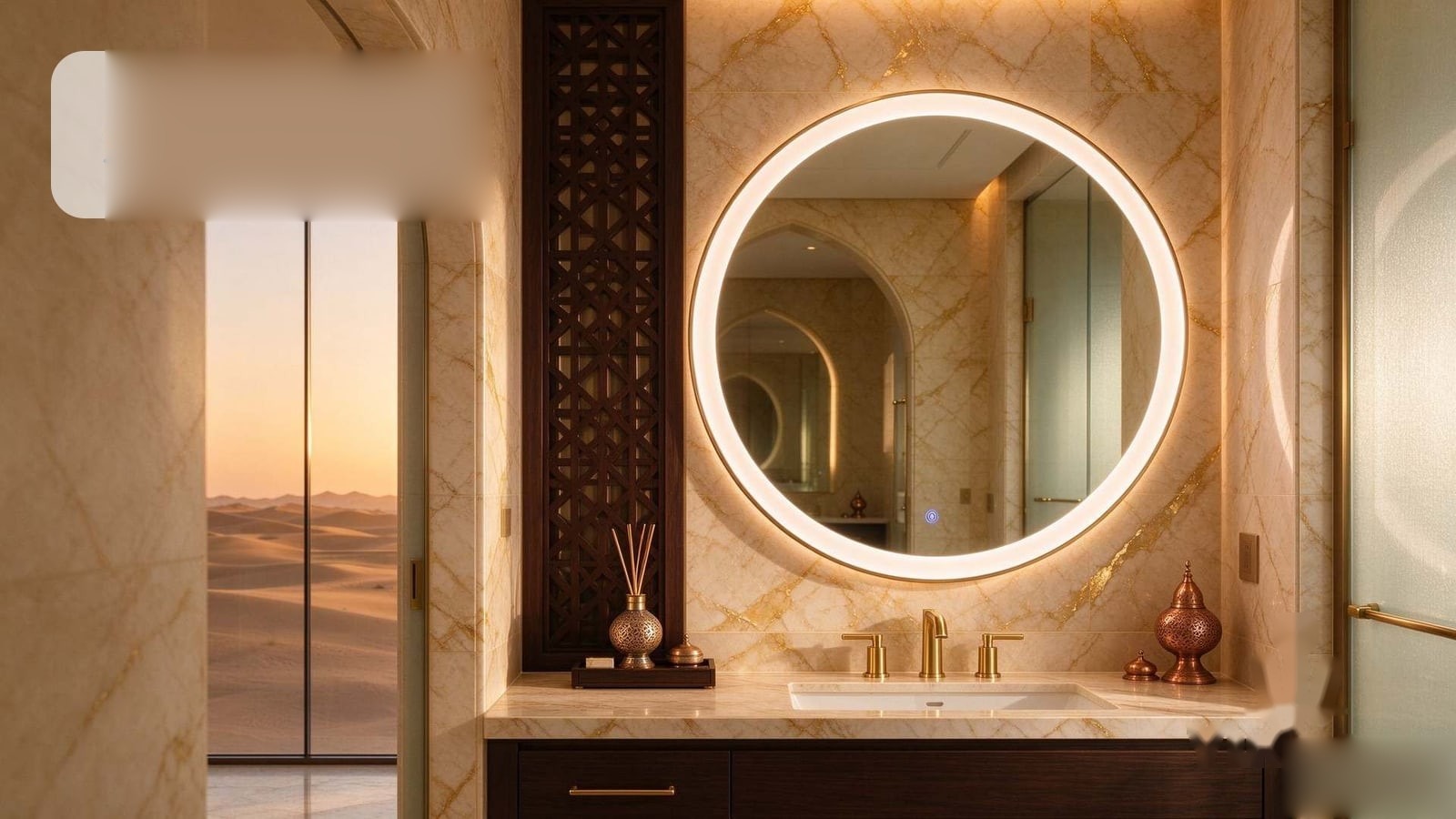
Selling full-length mirrors into the Gulf works differently from selling into Europe or the United States. The buyer is often a hospitality fit-out contractor, a villa interior studio, or a furniture distributor in Riyadh, Jeddah, Dubai or Doha — and the deciding factor is rarely the glass alone. It is whether the supplier can ship mirror orders that clear Saudi SABER or UAE ECAS without a demurrage story, survive 50°C warehouse summers, and land gold or brass finishes that match a majlis palette. This guide maps the mirror categories Gulf buyers actually order, the certification sequence that governs the customs calendar, and the specification details that separate a repeatable import program from a one-off container.
What the Gulf Market Actually Orders
Demand splits into three channels, and each pulls a different mirror type.
Hospitality and giga-projects. Saudi Arabia's project pipeline — NEOM, Qiddiya, Diriyah Gate, the Red Sea developments — and the UAE's hotel refurbishment cycle drive bulk orders of wall-mounted and leaning full-length mirrors for guest rooms, corridors and gyms. Buyers here order in container quantities and expect backboards and packaging aligned with Civil Defense fire-safety expectations.
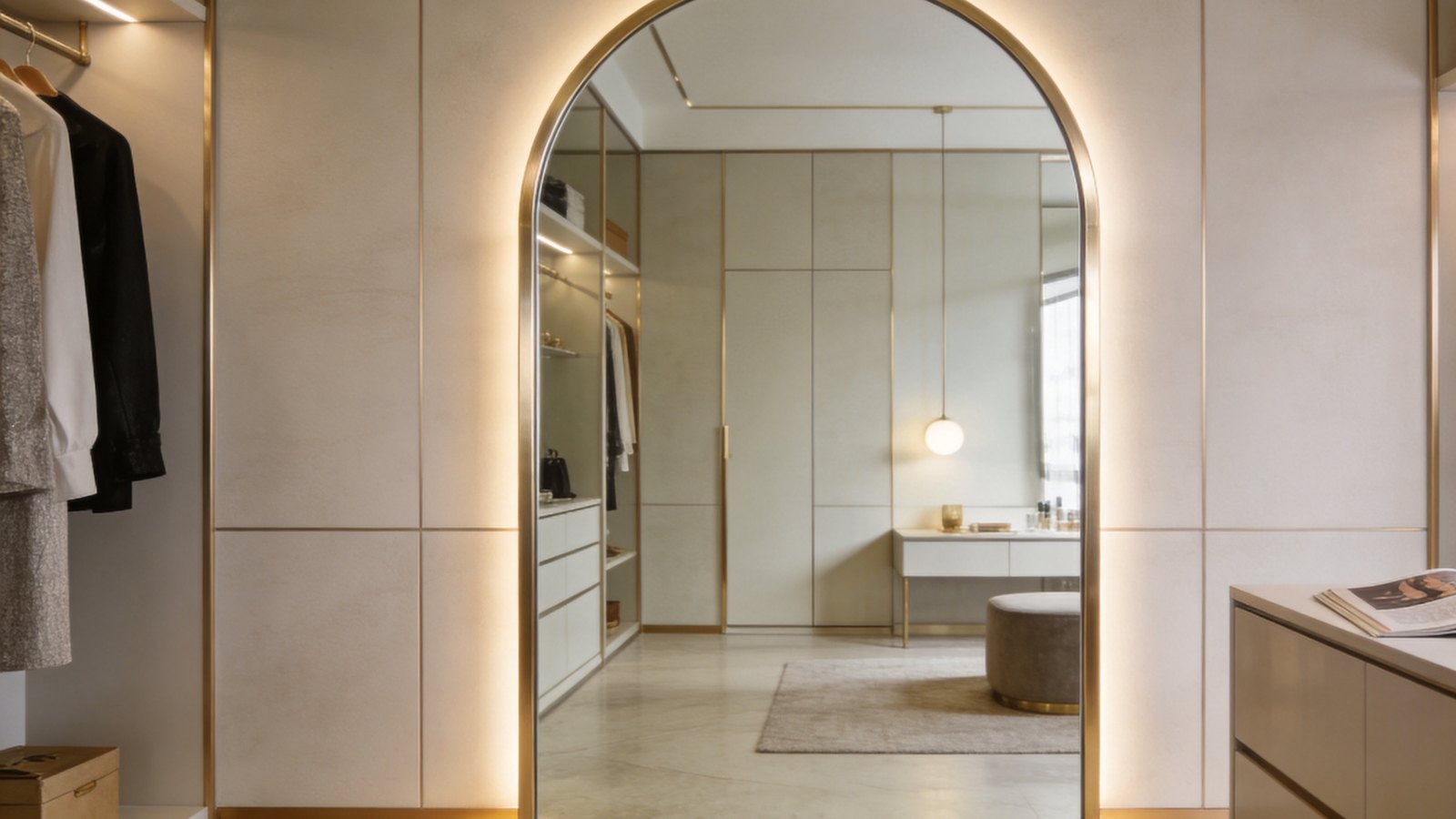
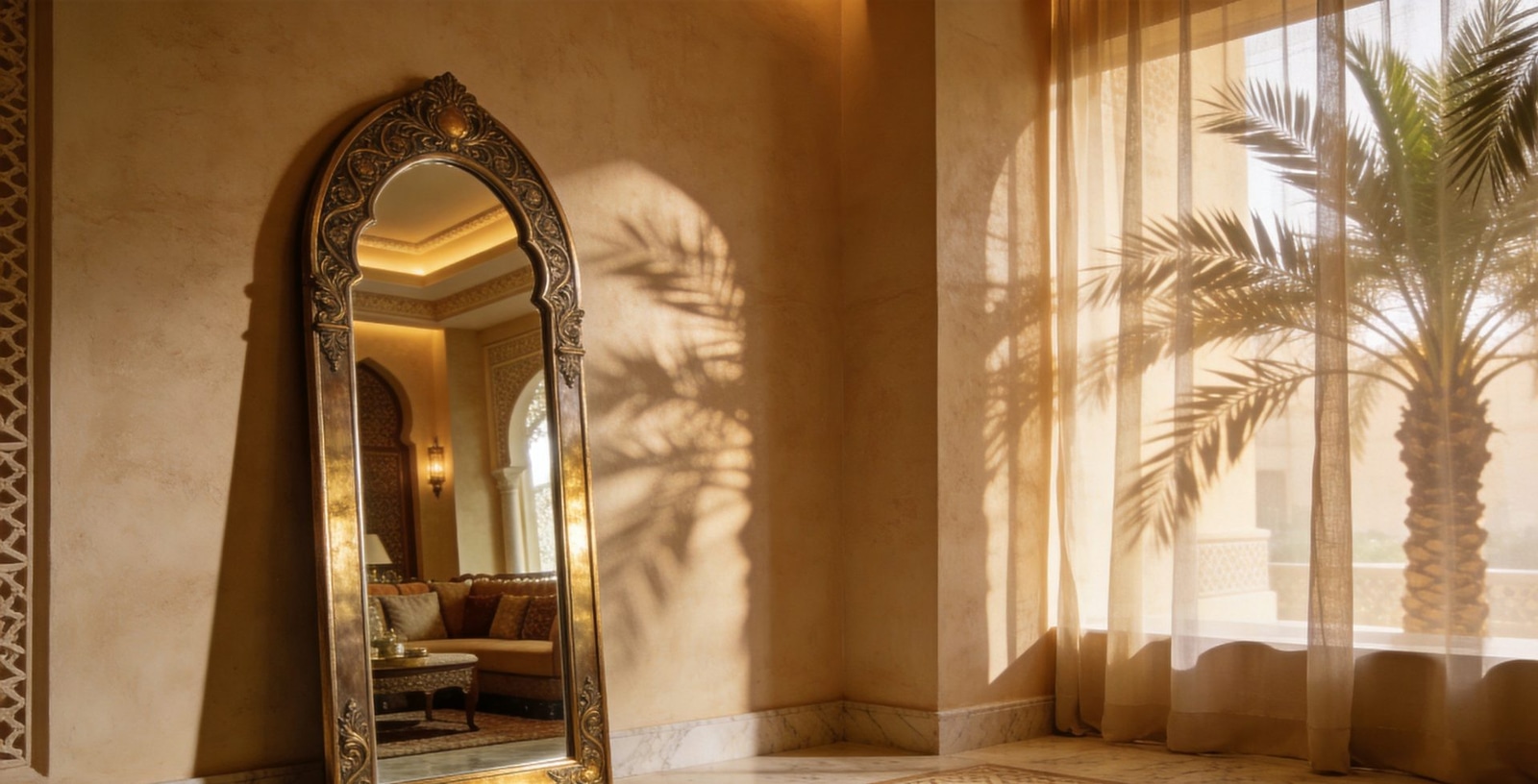
Villa and apartment interiors. Private residential work in Riyadh, Jeddah, Dubai and Abu Dhabi favors arched and gold-finish mirrors as statement pieces in entryways, dressing areas and majlis rooms. Brass-framed arches and carved gold frames move here in mixed-size batches rather than single-SKU containers.
Retail and furniture distribution. Distributors servicing furniture souks and retail chains want a range of sizes — roughly 40×150 cm through 80×180 cm — with consistent framing so a family of mirrors merchandises together. They buy on price ladder, MOQ flexibility and lead time.
Across all three, the constraints repeat: mirrors must tolerate extreme heat in transport and storage, finishes must not tarnish under coastal humidity in Jeddah or Dubai, and packaging must survive a sea leg plus a hot drayage to the final warehouse.
Saudi Arabia: The SABER Sequence That Sets Your Timeline
Saudi Arabia runs the region's strictest import regime, and the certificate sequence — not production — is usually the critical path.
- PCoC first, at order confirmation. Every consumer product category under SABER requires a Product Certificate of Conformity (PCoC) before a Shipment Certificate can be issued. The PCoC is valid for roughly one year and documents that the mirror line meets the applicable Saudi/GCC technical requirements. Start it when you confirm the order, not after the goods leave the line — treating certification as a post-production errand adds weeks while containers sit.
- SCOC per shipment. Each shipment then needs its own Shipment Certificate of Conformity (SCOC) tied to the commercial invoice and packing list. Clearance runs through the FASAH single window; without a valid SCOC the shipment stalls at port with demurrage accruing daily.
- Budget the landed-cost add-ons. Furniture and mirror products typically attract a customs duty around 15% of CIF value — above the 5% GCC baseline — plus 15% VAT. Buyers quoting ex-works often underestimate this stack; price your offers with the duty band visible so the landed math is honest.
- Label at the sample stage. Arabic-language labelling and a permanent "Made in [country of origin]" marking on the product are required. These cannot be retrofitted onto a finished container — decide label layout, language placement and origin marking when you approve the pre-production sample, because the frame and backing are where the marking physically lives.
One more planning note for 2025-2026 schedules: Red Sea routing disruptions have pushed some buyers toward dual-port strategies, splitting large programs between Jeddah and Dammam. Ask your supplier to quote both port pairs so your forwarder can shift legs without renegotiating the goods.
UAE and the Rest of the Gulf: Do Not Assume One Certificate Covers All
The UAE runs its own conformity scheme — ECAS — and a Saudi SABER certificate does not substitute for it. If your program covers both markets, plan two certification tracks in parallel, or consolidate UAE-bound volume with a distributor who holds the local registration.
The practical upside: UAE clearance is generally faster and more documentation-driven than Saudi's product-certification-first model, so many programs run Saudi volume on the SABER calendar and let UAE volume follow a few weeks behind. Kuwait, Qatar, Bahrain and Oman sit closer to the GCC baseline at lower duty intensity.
Heat, Humidity and Finish: The Specification Details That Matter in the Gulf
Three specification decisions determine whether a mirror still looks right six months after delivery in this climate.
Frame finish against heat and coastal humidity. Gold and brass finishes are the region's commercial workhorses, but plating quality varies widely. For coastal cities, request salt-spray test data on the frame finish and confirm the backing: full-length mirrors should use a moisture-resistant backing that will not delaminate when a container crosses a hot, humid quay.
Glass and reflection quality for statement placements. In majlis and hotel lobby placements, the mirror is a wall feature, not a utility. Distortion control matters — flatness of the silvering determines whether a 180 cm arch reads as luxury or as a funhouse. For a full method on checking distortion, glass grading and safety backing at the factory, see our full-length mirror quality control checklist.
Packaging for a sea leg plus desert drayage. Corner protection, full-edge foam and a drop-tested carton are baseline; the Gulf adds a long final mile over hot roads. Packaging standards here overlap with e-commerce drop testing rather than diverge from it.
What to Verify on the Supplier Side
Before committing a Gulf program to a factory, four checks save the most grief:
- Ask for the PCoC/SCOC track record. A factory that has shipped Saudi-bound mirror programs has an accredited conformity body it works with and can quote the realistic certificate turnaround.
- Confirm MOQ and size-range coverage. Full-length mirror programs typically run MOQ 50 units per model, with some sizes down to 20 — enough to build a mixed-size container without single-SKU overbuying.
- Lock lead time against the certificate calendar. Standard production runs 15-25 days; if certification starts only after production, the door-to-door timeline extends by the certificate queue. Run both in parallel.
- Sample for finish approval in market lighting. Gold tones read differently in the warm 2700K lighting that is the default in Gulf interiors. Approve the physical sample under it.
For buyers combining smart or LED-lit mirrors with conventional full-length pieces in one program — common in hotel fit-outs — the electrical dimension (Type G plugs, IP ratings, driver certification) adds another layer; our smart mirror sourcing guide for the UAE, Saudi Arabia and the GCC covers that half in detail.
One PO, Two Certification Worlds
The Gulf run is not an extension of the European file. Saudi conformity rides on the SABER platform operated by SASO, the UAE keeps its own ECAS route, and the same mirror heading to Germany or France instead would travel on a technical file the importer signs under the General Product Safety Regulation.
| Destination | Certificate chain | Labelling rule |
|---|---|---|
| Saudi Arabia | PCoC + SCOC via SABER | Arabic label, HS-code aligned |
| UAE | ECAS conformity route | Bilingual English/Arabic |
| EU (for comparison) | CE DoC + GPSR technical file | Importer of record on the DoC |
Matching a Format to the Gulf Pack
The floor and full-length range lists the 15 stock formats, heights and finishes; check the finish against 2700K store lighting before fixing the PO, because brass and gold read differently under warm light than under daylight.
FAQ
Is SABER certification required for full-length mirrors imported into Saudi Arabia?
Yes. Full-length mirrors fall under Saudi Arabia's product conformity system: you need a PCoC covering the product line, plus an SCOC for each shipment, before clearance through FASAH. Budget the PCoC at order confirmation because it gates everything downstream.
Does a Saudi SABER certificate also cover UAE imports?
No. The UAE operates the separate ECAS conformity scheme. A program covering both countries needs two certificate tracks, though they can run in parallel with the same technical file.
What duty and VAT should I budget for mirrors into Saudi Arabia?
Plan for customs duty of roughly 15% of CIF value for furniture-class goods, plus 15% VAT. Confirm the exact HS classification with your broker before quoting.
What mirror styles sell best in the Middle East?
Arched and gold-finish full-length mirrors dominate residential and hospitality statement placements; brushed brass and carved gold frames both move well. Hotels additionally buy rectangular leaning and wall-mounted mirrors in bulk for guest rooms.
Can one factory supply mixed sizes in a single container at reasonable MOQ?
Yes — that is the standard program shape. Full-length mirror lines typically run MOQ 50 per model with selected sizes at 20, so a distributor can build a mixed-size container from 40×150 cm to 80×180 cm without single-SKU overbuying.
How does the climate affect mirror quality requirements?
Extreme heat and coastal humidity in Jeddah, Dubai and Dammam make frame plating, moisture-resistant backing and salt-spray-tested finishes the points that fail first. All three are factory-verifiable at the sample stage.
Bottom Line
The Gulf rewards suppliers who treat certification as a parallel track and finish durability as a spec, not an afterthought. Build the program around a SABER-ready factory, approve gold and brass finishes under warm lighting, lock label and origin marking at the sample stage, and quote with the duty-and-VAT stack visible. Do that, and full-length mirror imports into Saudi Arabia and the UAE become repeatable business rather than a customs gamble.