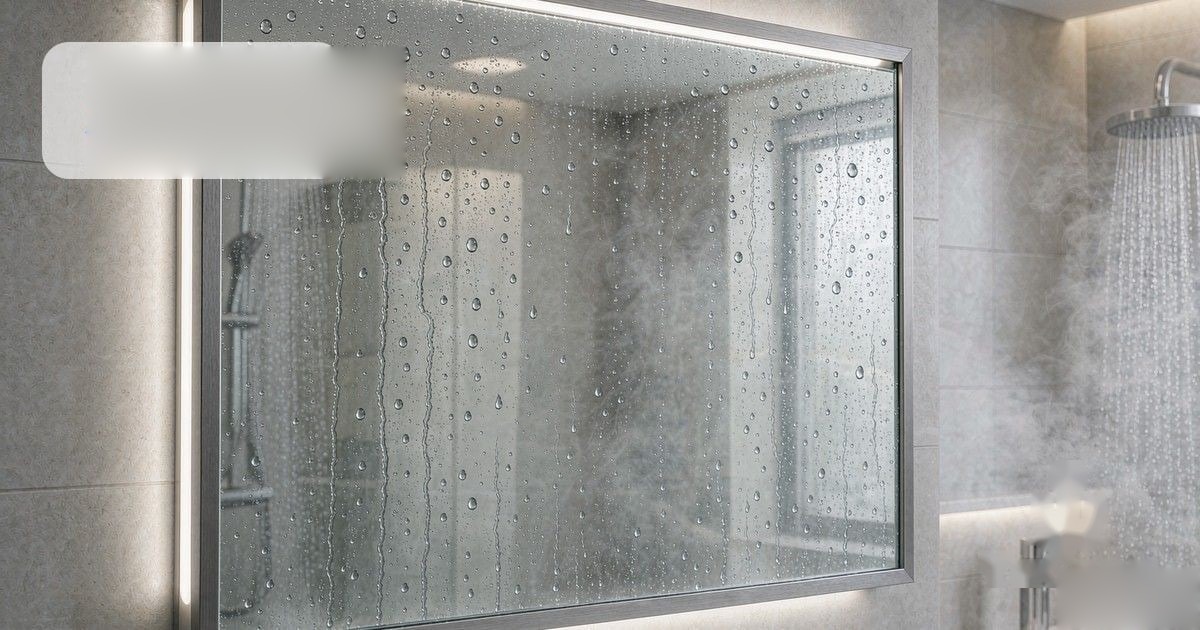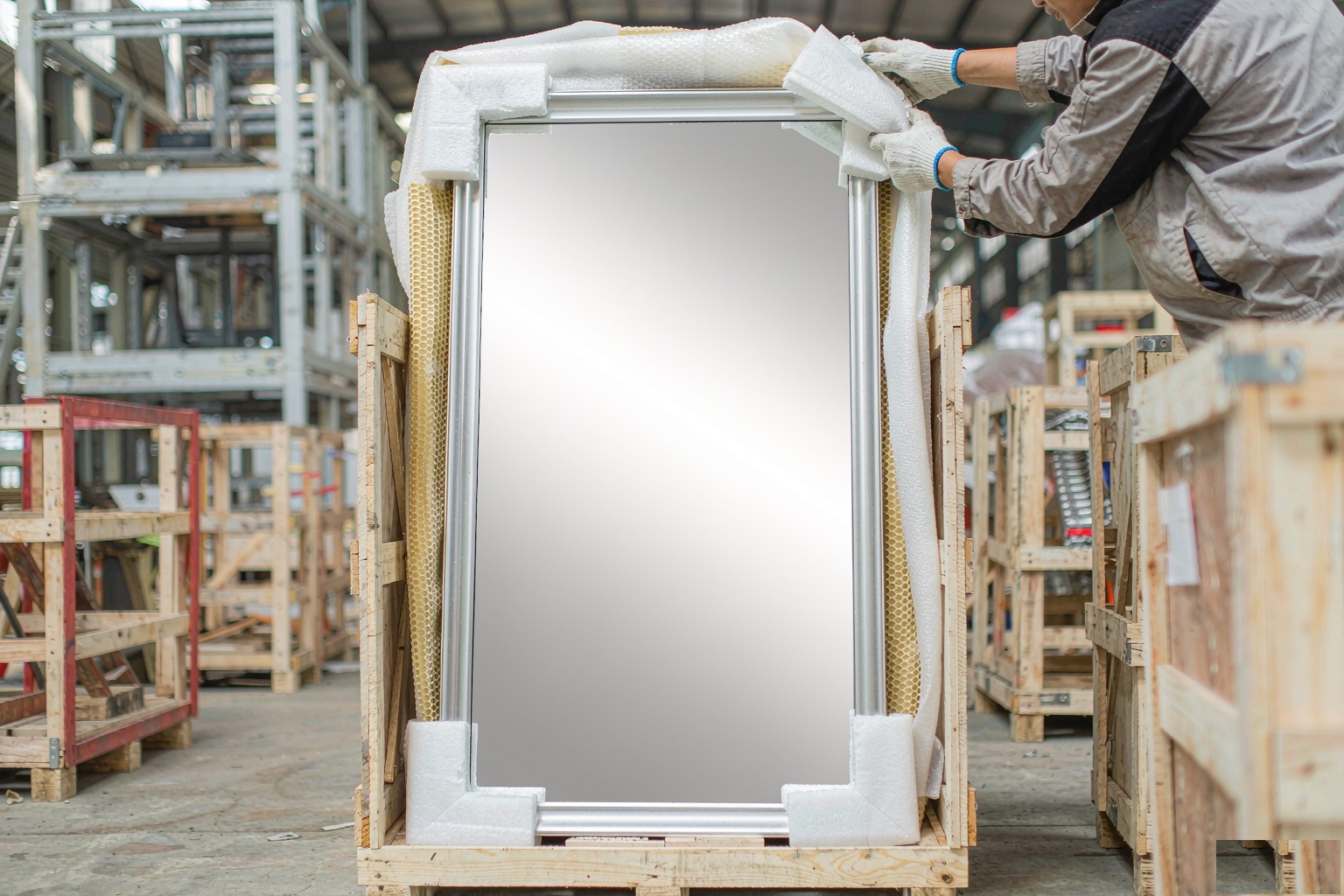
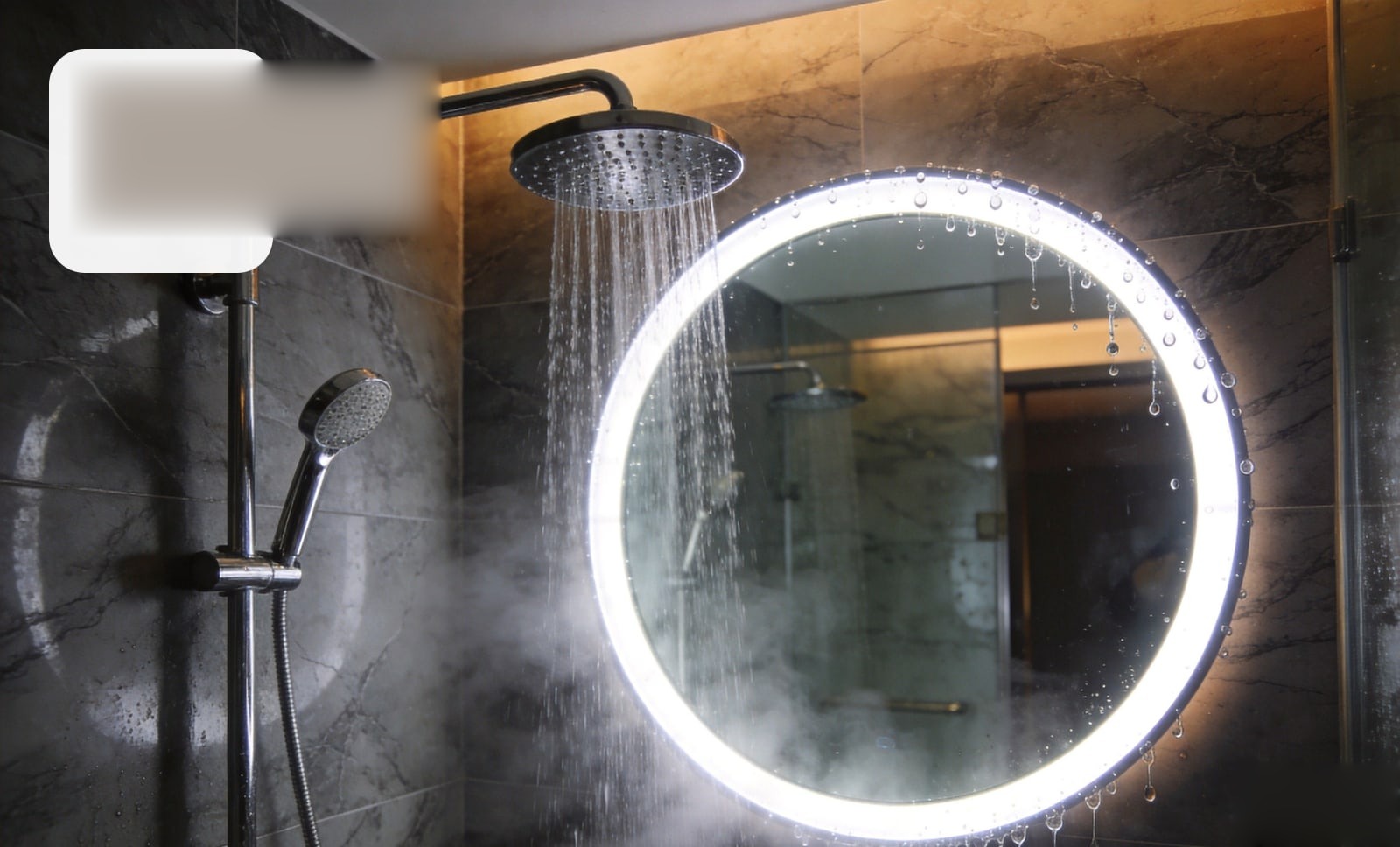
IP66 means two things at once, and both matter in a bathroom: the enclosure is completely dust-tight (first digit 6), and it withstands powerful water jets (second digit 6) — a 12.5 mm nozzle delivering 100 litres per minute from 2.5–3 metres, per IEC 60529. In practice, that is the rating you specify for a mirror or display that will sit where shower spray and wet-room humidity hit it directly. For everything else in a bathroom, IP44 usually suffices. Here is what the rating actually tests, how it compares with IP54/IP65/IP67, and where each one belongs.
The Two Digits, Decoded
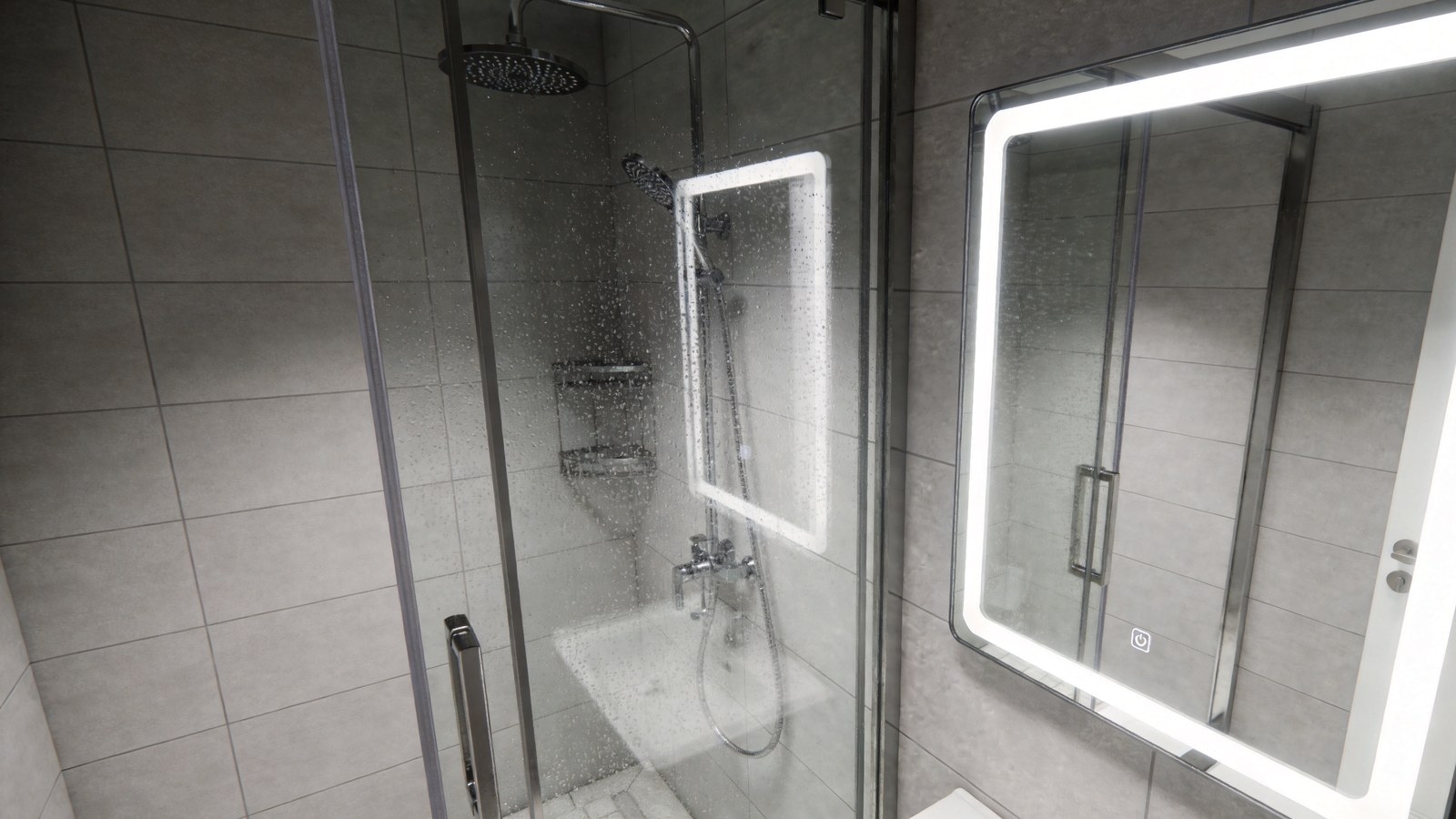
An IP rating is a two-character verdict defined by IEC 60529 (in Europe, EN 60529). The first digit grades protection against solids, from 0 up to 6. Digit 6 is the ceiling: no dust ingress at all, verified in a talcum-powder chamber with a vacuum pulling air through the seals for up to 8 hours. The second digit grades protection against water, from dripping (1) through splashing (4) and jets (5–6) to immersion (7–8).
So IP66 is not "66% waterproof" or a marketing tier — it is two separate pass/fail laboratory tests, and both must be met independently.
What the IP66 Test Actually Involves
The water-jet test is more violent than most buyers assume. The enclosure is sprayed from every practicable direction with a standard 12.5 mm nozzle at 100 litres per minute — roughly eight times the volume of the IPX5 test — at a distance of 2.5 to 3 metres, for at least one minute per square metre of surface and never less than three minutes total.
The pass criteria are worth reading closely, because they explain what the rating does and does not promise: water may enter, provided it does not interfere with correct operation or impair safety. For a bathroom mirror with a 110–240V driver inside, that is why the chassis sealing and the driver housing are engineered as separate barriers — on our wall-mounted LED mirror range, the constant-current driver carries its own IP67 rating while the mirror body is offered in IP65, IP66, IP54 and IP44 variants.
IP Ratings Compared: The Numbers That Matter
| Rating | Solids | Water | Test condition | Typical bathroom use |
|---|---|---|---|---|
| IP44 | 1 mm tools/wires | Splashing from any direction | Spray nozzle, 10 L/min | Zone 2 vanity mirrors, standard bathrooms |
| IP54 | Dust-protected | Splashing | Same water test as IP44 | Dustier install environments |
| IP65 | Dust-tight | Water jets, 6.3 mm nozzle | 12.5 L/min at 30 kPa, 3 m | Direct splash zones, shower-adjacent walls |
| IP66 | Dust-tight | Powerful jets, 12.5 mm nozzle | 100 L/min at 100 kPa, 2.5–3 m | Direct shower spray, wet rooms |
| IP67 | Dust-tight | Temporary immersion | 1 m deep, 30 minutes | Submersion-rated equipment |
Read the table vertically and one conclusion jumps out: the step from IP44 to IP65 is about jets, not steam. A standard bathroom mirror at IP44 handles splashes; the moment a showerhead can aim at the glass, you need the jet ratings.
IP66 vs IP67: The Counter-Intuitive Part
Many buyers assume IP67 outranks IP66 the way 7 beats 6. The two tests measure different failure modes, and passing one does not guarantee the other.
IP67 submerges the enclosure 1 metre deep for 30 minutes — static, uniform pressure that often presses seals tighter. IP66 fires a focused, high-velocity jet at the sealing faces; the dynamic pressure spike can peel a gasket lip open in a way still water never will. Test labs report enclosures that pass IP67 immersion yet fail the IP66 jet — which is why serious specifications for spray-exposed equipment ask for both, and why a driver rated IP67 does not by itself make a mirror shower-proof.
Where IP66 Belongs in a Bathroom
Bathroom wiring zones give the practical answer. Inside the shower tray or bath (zone 0), equipment faces immersion-level exposure. Zone 1, directly above and around the shower, is where spray lands with force — this is IP65/IP66 territory for anything electronic. Zone 2, within 0.6 m of the bath or shower edge, and the rest of the room typically require IP44 minimum.
For B2B buyers the mapping is straightforward:
- Hotel standard rooms — vanity mirror at IP44 with an IP67 driver; the overwhelming majority of projects.
- Wet rooms and open-plan showers — IP65 or IP66 mirror variants, because spray reaches the glass directly.
- Spa, poolside and gym applications — IP66, plus salt/chlorine-resistant hardware considerations.
- Mirrors with displays or touch electronics inside shower zones — IP66 chassis, sealed touch controller, no cut-outs.
Our stock bathroom line ships at IP54 — sealed junction box, silicone-sealed LED strip, aluminium back panel — which covers over-basin and sheltered positions. IP65 and IP66 enclosures are built to order on the same chassis family, so project buyers can still specify per zone instead of sourcing two different mirrors.
What to Write Into the Purchase Order
Three lines in a PO prevent most IP disputes:
- State the rating per variant, not per "range". A catalogue that leads with "up to IP66" tells you nothing about the SKU you are buying; ours states the rating per model, not per range.
- Ask which part of the product carries the rating. Mirror body and driver are separate: a mirror can be IP66 as a chassis with an IP67 driver, or marketed on the driver's rating alone. Confirm both.
- Request the test report, not just the marking. IP ratings are self-declared more often than buyers expect; a report from an accredited lab (the same documentation stream as CE and ETL listing) turns the claim into an auditable fact.
For European projects, the zone-by-zone electrical requirements behind these choices are covered in detail in LED Bathroom Mirror IP Ratings: Europe Buyer's Guide; US hotel projects will find the matching specification framework in Hotel Bathroom Mirror Specs for US Wholesalers.
FAQ
What does IP66 mean in a bathroom? Complete dust-tightness plus protection from powerful water jets — a 12.5 mm nozzle at 100 L/min from 2.5–3 m, tested per IEC 60529. In a bathroom, it is the rating for mirrors or electronics exposed to direct shower spray.
Is IP66 better than IP65? For spray exposure, yes: IP66 delivers eight times the water volume (100 vs 12.5 L/min) from a larger nozzle at higher pressure. A unit passing IP66 will pass IP65; the reverse is not true.
Is IP67 better than IP66 for a bathroom mirror? Not automatically. IP67 tests 30-minute immersion at 1 m; IP66 tests high-velocity jets. Some enclosures pass immersion but fail the jet test. For shower spray, specify IP66; for submersion scenarios, IP67.
What IP rating does a normal bathroom mirror need? Outside the direct spray area, IP44 is the accepted minimum for zone 2 and general bathroom use. Add an IP67-rated driver for the electronics, which is standard on quality LED mirrors.
Do LED bathroom mirrors come in different IP variants? A: Yes. Our bathroom mirror line ships at IP54 as stock; IP65 and IP66 enclosures are built to order on the same chassis family, so one platform can still be specified zone by zone within a project.
Does an IP rating cover steam and humidity? The tests use liquid water, not vapour. Steam resistance comes from the coating and sealing discipline — copper-free silver mirror glass, sealed edges, conformal-coated electronics — which is why IP rating alone does not predict how a mirror ages in a wet room.
Reference & Standards
- Reference note: IP-code digits are defined in IEC 60529, the standard the whole IP table hangs on (view)