
Wholesale Full-Length Mirrors: 2026 Amazon Sourcing Guide
Full-length mirrors are one of the few home categories where Amazon margins survive 2026 freight — for sellers who pick the factory on damage rate, compliance file and dimensional weight rather than unit price. This guide runs the vetting sequence in the order the money moves.
What the Category Sells in 2026
Search demand has shifted from plain rectangular panels toward arch-top silhouettes, slim black frames and LED backlit borders. Sizes concentrate around 160–180 cm: tall enough to show a full outfit, narrow enough to move as oversize parcel instead of freight. The underlying glass spec stays constant while the looks rotate — 4–5 mm silver glass with safety backing — so a factory that already ships the three winning formats can carry a whole season.
Vetting a Mirror Factory: Five Verifiable Checks
| Check | What to ask for | Red flag |
|---|---|---|
| Audit status | Current BSCI or equivalent report | "We can arrange it later" |
| Drop test | Carton drop-test protocol plus photos | "Standard export carton" as the full answer |
| Glass source | Silver glass supplier and thickness tolerance | Thickness quoted as approximate |
| Finish samples | Edge polish and frame corners from the last batch | Studio-only images |
| Export history | Markets shipped in the last 12 months | No US or EU shipment experience |
A factory that answers all five in writing is negotiating. One that answers three is quoting.
Packaging: Where the Margin Actually Lives
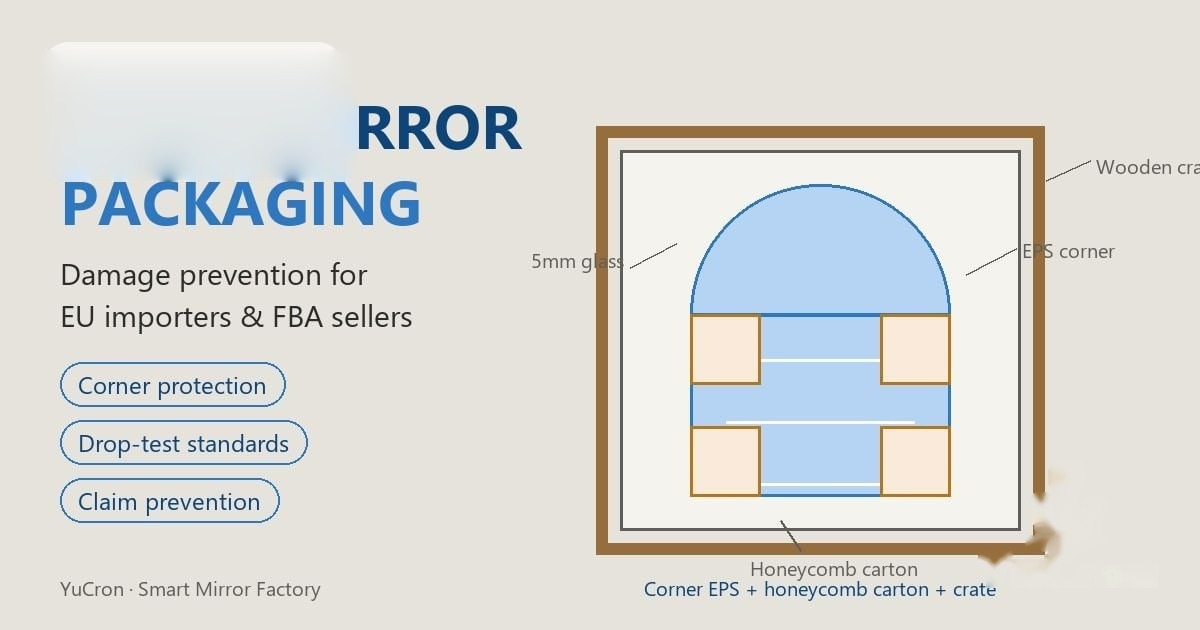
Damage on a 170 cm pane is not a warranty line item; it is a business-model decision. Insist on corner posts, full-perimeter cushioning and a documented drop-test protocol. The compliance twin of packaging is glass safety: safety-backed glass tested against the impact classes referenced in 16 CFR 1201 is the spec line US retailers and insurers recognize, and EU-bound orders add the technical file the importer signs under the General Product Safety Regulation.
Compliance Files by Market
| Market | File that gates the listing | Note |
|---|---|---|
| United States | Glass safety class plus supplier test reports | CPSC keeps the public recall record |
| European Union | CE DoC plus GPSR technical file | Importer of record signs |
| Amazon EU inbound | Electrical and safety documentation per listing | Seller requirements |
Landed Cost Without Wishful Thinking
Unit price is the smallest number in the quote. The sequence that decides profit: unit price plus sea freight per unit plus duty plus referral fee, minus returns — and returns on fragile SKUs are dominated by transit damage. Sellers who model a 2–3% damage rate before ordering, and a higher one on thin-carton suppliers, price their listings correctly the first time.
From Sourcing to Launch
Order the trial container mixed across the three winning formats, keep one SKU per carton dimension, and photograph the unboxing yourself. The photos double as listing content and as the packaging audit you show the factory before the re-order.
The Three 2026 Formats, Spec'd
The arch-top mirror runs 160–180 cm with the curve adding visual height without width, which is why it converts in listings — but the arch is the expensive edge to polish, so ask how the factory handles arch distortion: flatness of the silvering decides whether a tall arch reads clean or wavy at two metres. The slim black frame format, roughly 40 x 150 cm at the compact end and up to 80 x 180 cm in full-height silhouettes, is the volume SKU — cheapest to box, cheapest to hang, and the one where a thin carton destroys the economics. The LED backlit border adds an electrical file to the same glass: driver, plug and test report per market, plus the listing-copy discipline to not claim bathroom ratings the SKU does not carry.
Buyers who spec all three formats on the same glass family — same thickness, same backing, same finish process — negotiate from one quality baseline instead of three.
Questions That Reveal Supplier Experience
Two questions separate mirror factories from mirror traders. "What does your drop-test report show for the 170 cm carton?" — an experienced factory answers with a protocol and photos. "Which of your formats moved to the US or EU in the last twelve months?" — an exporter answers with months and ports. Traders answer both with reassurance, and reassurance is not a spec.
Checking the Stock Ladder First
The floor and full-length range lists the stock formats and finishes that ship in 15–25 days, which is where an Amazon seller should start before committing to a custom run.
FAQ
What size full-length mirror sells best on Amazon?
160–180 cm panels in arch or slim black frame formats dominate the current category look, and the size range keeps the carton inside oversize-parcel limits.
Do full-length mirrors need safety-backed glass?
US retail listings increasingly cite impact-tested safety backing, with test classes referenced in 16 CFR 1201; EU sellers carry the same expectation through the technical file.
How do I price damage risk into the order?
Model 2–3% transit damage as a baseline, add the repack or disposal cost per unit, and require the factory's drop-test protocol in writing before the deposit.
Is BSCI necessary for a first order?
Not for a trial container, but audit status predicts the packaging discipline that decides damage rates at scale. Ask for the report date, not the logo.