
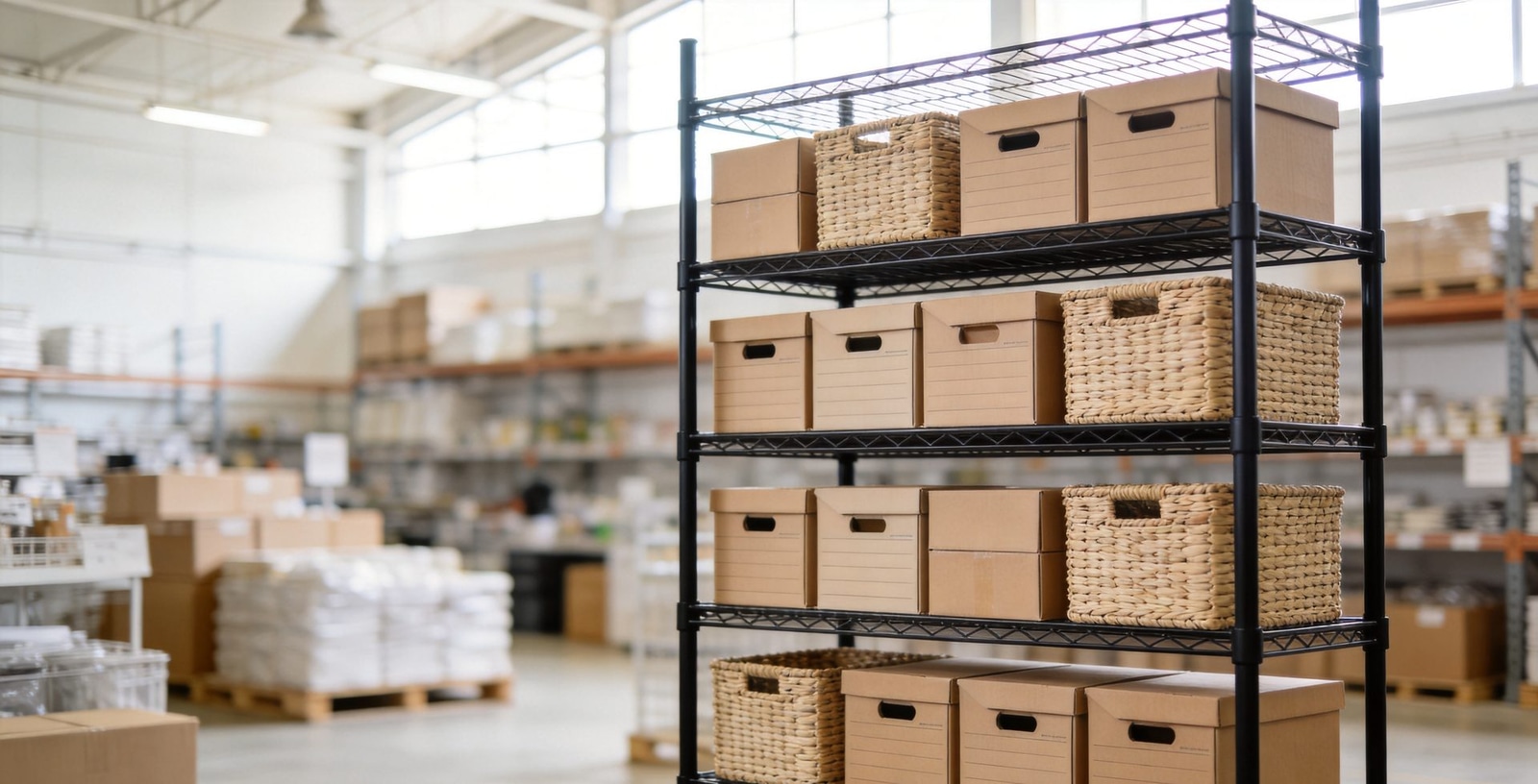
Importing storage racks into the United States, the European Union and the Gulf now turns on compliance paperwork as much as on steel gauge. Since December 2024, Amazon deactivates EU listings that miss GPSR responsible-person and labeling data; Saudi Arabia clears consumer goods only with a SABER certificate behind them; and US-bound shipments get reviewed against tip-over expectations that keep tightening. The buyers who win repeat orders are the ones whose factory can hand over test reports, anchor hardware and marketplace-ready documentation with the first quote. This guide walks through what each region actually demands, what Amazon FBA adds on top, and how to verify a storage rack supplier before wiring a deposit.
Who Orders What: Three Channels, Three Rack Types
Amazon and marketplace sellers run short SKU cycles. They buy light-duty knockdown shelving — 3-to-5-tier units that pack flat, assemble without tools and survive parcel networks. Their non-negotiables are marketplace compliance documents, e-commerce packaging and consistent batch quality, because a listing suspension costs more than the tooling ever will.
B2B distributors and wholesalers build multi-year programs. They order wider size matrices, negotiate MOQ ladders, and care about finish durability, load-rating consistency and freight density. For the engineering side of load-bearing design and container optimization, our commercial shelving systems sourcing guide covers the structural checks importers should demand at the sample stage.
Hospitality, office and retail fit-out buyers want spec-grade units — hotel back-of-house shelving, retail display racks, pantry storage. They ask for stability reports, mounting hardware and finish samples approved under project lighting.
The US: Know What the Tip-Over Rule Covers — and What It Does Not
The STURDY Act rule at 16 CFR Part 1261 makes ASTM F2057-23 a mandatory federal standard, but its scope is clothing storage units — dressers, chests and wardrobes above 27 inches. Open storage racks and shelving without drawers sit outside that rule, so do not let a factory sell you a "STURDY certified rack" story: no such certification category exists for open shelving.
What US marketplaces and retailers do expect is evidence of reasonable stability practice: documented load ratings, wall-anchor hardware in the box, assembly instructions that state anchoring for tall units, and batch-tested shelf supports. Ask for the factory's internal load and deflection test records — how shelves, brackets and supports behave under stated load × safety factor — and keep them on file for platform safety audits.
The EU: GPSR Is the Gatekeeper for Amazon Sellers
Since 13 December 2024 the General Product Safety Regulation applies to most non-food consumer products sold in the EU — storage racks included. For marketplace sellers this is not theoretical: Amazon's GPSR requirements ask for an EU-based Responsible Person, manufacturer contact details on the product or packaging, at least one product identifier such as a GTIN, and warning or safety information in the language of the store where you sell. Listings that miss these fields get deactivated.
Two practical notes for rack programs. First, GPSR does not apply to Great Britain, though it does cover Northern Ireland — a separate UKCA conversation. Second, for domestic-use storage furniture, the product-level benchmark buyers reference is EN 14749, which specifies safety requirements and test methods for domestic and kitchen storage units — shelf loading, shelf supports, stability and wall-hanging hardware. Its scope is domestic only; office and industrial storage fall outside it, which is one reason the buyer's use-case statement should be settled before the test plan is written.
The Gulf: SABER Certificates Before the Container Sails
Saudi Arabia runs consumer-product imports through the SABER platform operated by SASO: a product certificate of conformity issued through an accredited conformity assessment body, then consignment certificates tied to each shipment. Furniture-class goods attract duty around 15% of CIF plus 15% VAT, and Arabic labelling with origin marking is enforced. The certificate sequence and its calendar implications are laid out in detail in our Middle East import guide — the same SABER logic governs storage racks. The UAE runs its own ECAS scheme; one Saudi certificate does not cover Dubai.
Amazon FBA: Package for the Network, Not Just the Ocean
FBA adds a layer on top of regional compliance. Oversize tiers punish bulky assembled racks, so knockdown flat-pack design with hardware in a taped bag is the default sellable format. Amazon's Ships in Product Packaging program tests whether a unit survives the network in its own carton under ISTA 6-Amazon style protocols — passes earn packaging fee reductions, failures mean mandatory prep. Ask the factory for drop-test data at carton level, corner protection specs and carton stacking strength, and match the packaging to the channel: double-boxed distributor cartons and parcel-ready FBA cartons are different products from the same line. The industrial metal shelving guide covers the warehouse-class side of this spectrum for buyers running mixed programs.
Supplier Verification: Five Checks Before the Deposit
- Ask for the test report, not the certificate logo. Load ratings, shelf deflection, stability and finish adhesion — dated, on letterhead, matching the model you are buying.
- Confirm the compliance paper trail per destination. GPSR responsible-person documents for EU listings, Arabic label artwork for Saudi, anchor kits and instructions for US retail.
- Sample the knockdown hardware. Cam locks, brackets and shelf pins are where cheap racks fail. Cycle-assemble the sample five times; if threads or clips degrade, walk away.
- Audit batch consistency. Powder-coat color and gloss across two production dates, shelf-hole alignment across units, hardware counts per carton.
- Fix packaging responsibilities in writing. Who designs the FBA carton, who pays ISTA-style drop testing, who owns a damage claim below the agreed threshold.
Compliance Matrix: US, EU and Gulf at a Glance
| Market | Rule that applies | What it covers | Document to ask for |
|---|---|---|---|
| US | STURDY Act rule at 16 CFR 1261 | Clothing storage units above 27 inches — open racks and shelving sit outside the scope | Scope confirmation, not a rack certificate |
| EU | GPSR | General product safety with a responsible economic operator on the label | DoC carrying the EU importer's details |
| Saudi Arabia | SABER | Product conformity (PCoC) and shipment clearance (SCOC) | PCoC and SCOC before the container sails |
| EU benchmark | EN 14749 | Shelf loading, shelf supports, stability and wall-hanging hardware for storage units | Test report against the standard |
FAQ
Does the STURDY Act apply to storage racks? No. The mandatory rule at 16 CFR Part 1261 covers clothing storage units such as dressers and chests. Open shelving and drawerless racks are outside its scope, though US marketplaces still expect documented load ratings and anchor hardware for tall units.
What does GPSR require for selling storage racks on Amazon EU? An EU-based Responsible Person, manufacturer contact information on the product or packaging, a product identifier such as a GTIN or batch number, and safety information in the language of the store. Amazon deactivates listings that miss these fields.
Is EN 14749 mandatory for storage racks in Europe? EN 14749 is the safety standard for domestic and kitchen storage furniture — its test methods are what EU buyers and inspection agencies reference for household shelving. It does not extend to office, retail or industrial storage, so the intended use-case decides which standard applies.
Do storage racks need SABER certification for Saudi Arabia? Yes for consumer-market shipments. Saudi consumer goods clear through SABER with a product conformity certificate plus per-shipment consignment certificates, issued through SASO-accredited bodies, alongside Arabic labelling and origin marking.
How should storage racks be packaged for Amazon FBA? Knockdown flat-pack, hardware bagged and taped, carton tested for parcel-network drops under ISTA 6-Amazon style protocols. Passing Amazon's Ships in Product Packaging test also reduces prep and packaging fees.
Can one supplier serve US, EU and Gulf programs simultaneously? Yes, when the factory maintains separate compliance files per destination — US load and anchoring documentation, EU GPSR and EN 14749-aligned reports, Saudi SABER certificates and Arabic labels — and can switch label artwork and carton specs between orders.
The Takeaway
Storage rack sourcing into these three markets is now a documentation business. Pick a supplier that treats test reports, responsible-person files and SABER certificates as deliverables, package for the channel that actually ships the parcel, and your rack program scales across regions without a compliance surprise at the border — or a deactivation notice in your seller account.