Mirror Search Types: Production, Project or Mood
Four phrases land in our inbox with surprising regularity: rectangular mirror, mirror room, small mirrors for crafts, and ultrafragola mirror. They look like they belong together because they all contain the word mirror. They do not. One is a production workhorse, one is a project schedule, one usually belongs to a different supply chain, and one is a mood reference. We build lit bathroom mirrors, custom mirrors for hospitality projects and vanity mirrors — so we see all four searches, and we see buyers mix them up.
This article is about sorting them before you ask for a quote.
Why do the four searches need four different answers?
Because the questions are different — put all four in one email and the quote will be wrong.
A rectangular mirror is a purchase order line. You can dimension it, pack it, replace it and repeat it.
A mirror room is a layout problem. You are not buying one object; you are matching dozens of objects across a wall, a corridor, a gym or a salon.
Small mirrors for crafts usually signals a consumer, a hobby seller or a small workshop. That buyer needs a different supplier.
And ultrafragola mirror is almost never a technical spec. It is shorthand for a wavy, illuminated, gallery-object look that designers save to a mood board.
Put those four in one email, and the quote will be wrong. Not because the factory is lazy — because the questions are different.
| Search phrase | What it really is | Where it belongs |
|---|---|---|
| rectangular mirror | A purchase order line | A factory that runs repeat batches |
| mirror room | A layout and documentation job | A project supplier with one spec |
| small mirrors for crafts | A consumer or hobby signal | A different supply chain |
| ultrafragola mirror | A mood reference | A design conversation under OEM/ODM |
Why is the rectangular mirror the shape that pays the freight?
Because it cuts efficiently, packs efficiently, and can be replaced three years later without a redesign.
If you ask anyone on our floor which shape moves, they will say the rectangle.
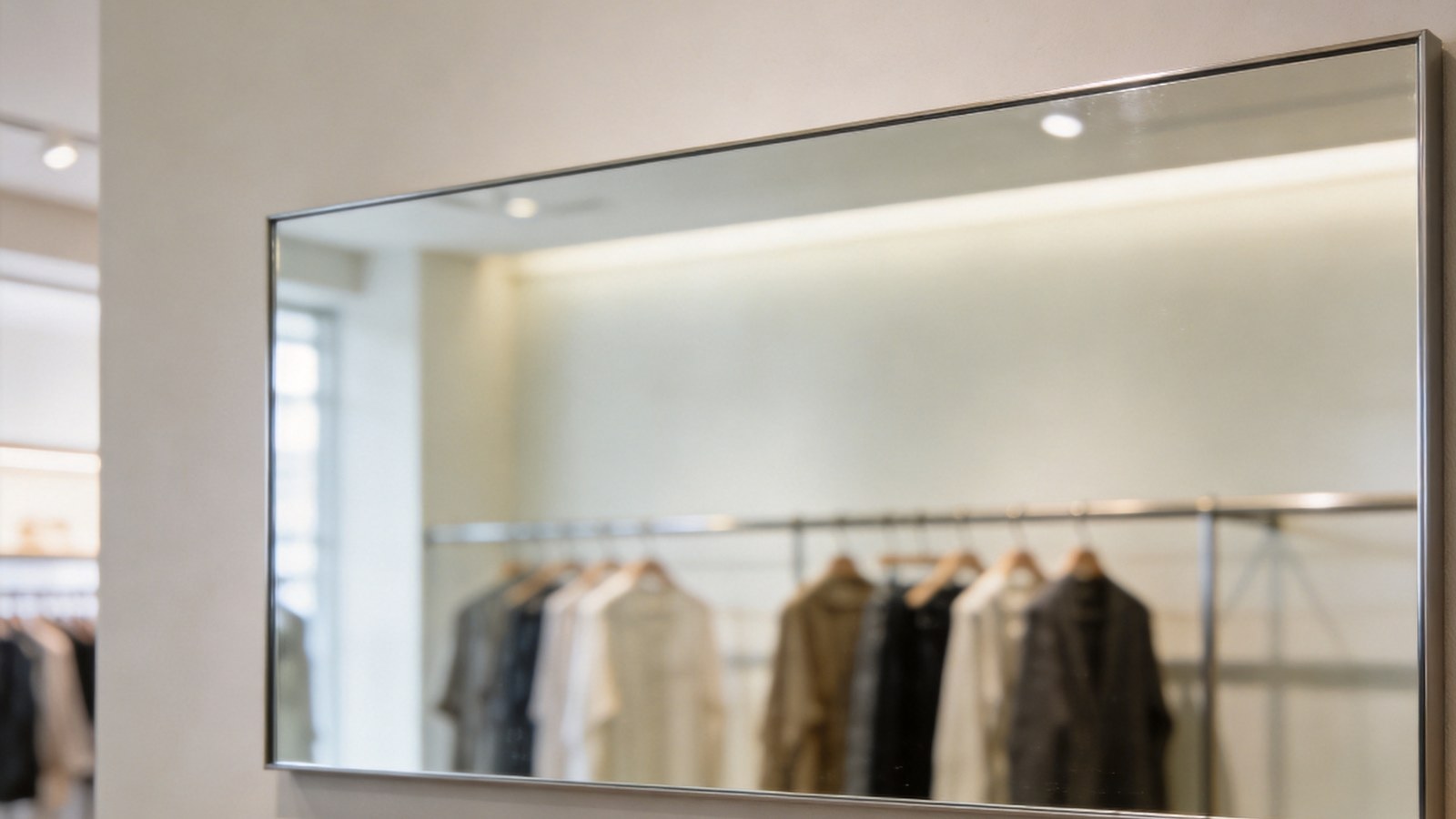
It fits the spaces where mirrors actually live: above a bathroom sink, beside a wardrobe, on a vanity wall, in a lift lobby.
That does not make the rectangular mirror boring. It makes it reliable. For a hotel custom mirror program, reliability matters more than a dramatic silhouette.
A property may need 40, 80 or 120 pieces. They all need the same width, the same height, the same edge, the same mounting points.
If one arrives 5 mm off, the installation crew notices. The maintenance team notices six months later, when a replacement does not sit flush.
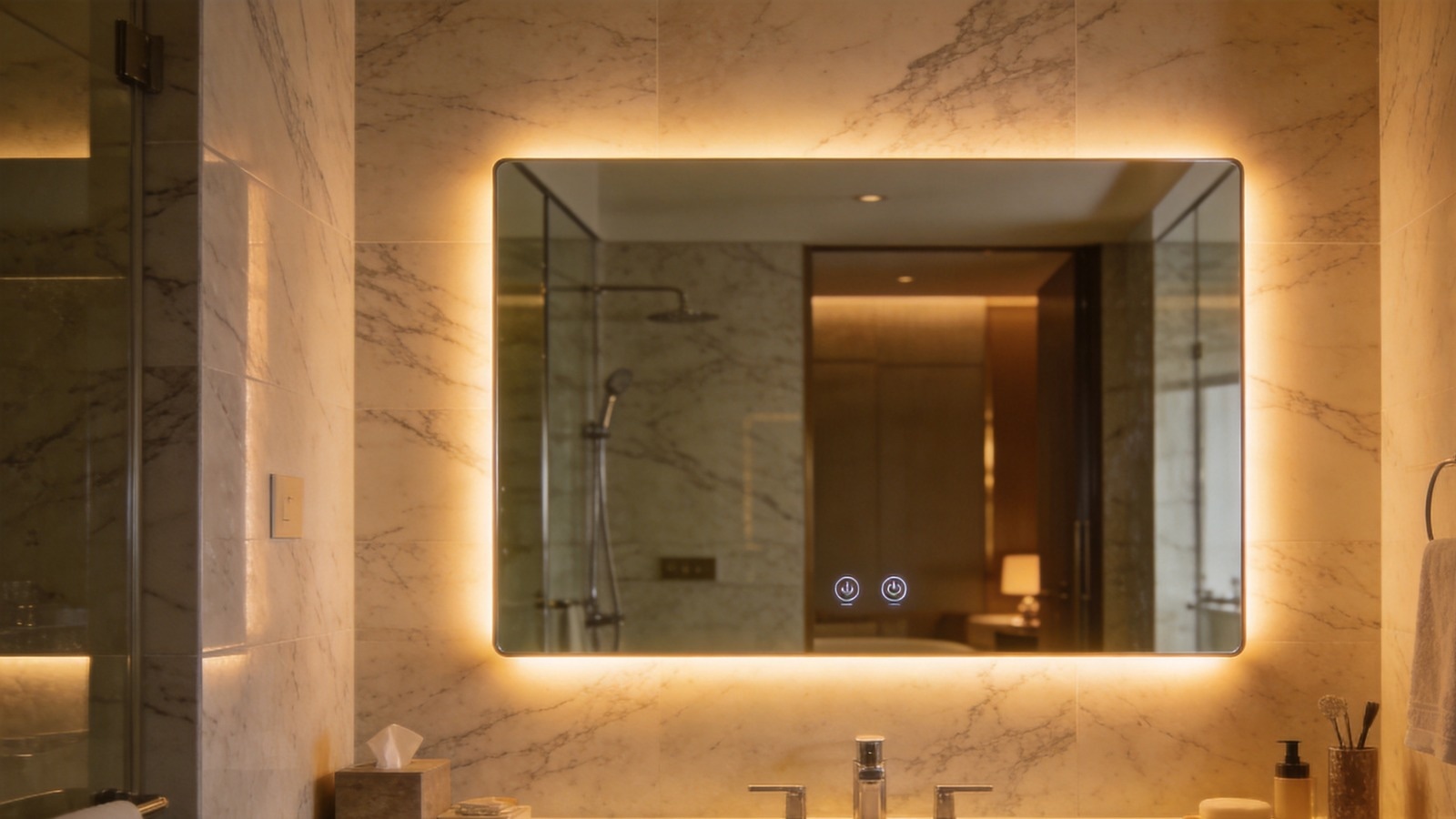
When the rectangular mirror includes LED lighting, the electrical layout becomes part of the drawing. Where does the driver sit? Where does the cable exit? Is the switch on the mirror or on the wall?
Those details do not show up in a screenshot. They show up in a production file.
Why is a mirror room a schedule rather than a purchase?
Because every room has a mirror, and the mirrors must match — underneath, it is a documentation decision.
Think about a hotel bathroom floor. Every room has a mirror, and the mirrors must match.
Think about a salon with six stations, where each mirror has a light temperature that must not make clients look green in photos.
Think about a residential project with a full mirrored wall, where the seams matter as much as the glass.
We have seen buyers treat a mirror room as a series of small purchases. That usually creates a mismatch.
The first batch arrives, the second batch arrives three months later, and the reflection has a different tint.
The edge looks slightly different, the mounting hardware changed, and now the designer is unhappy and the contractor is back on site.
For hospitality and multi-unit work, the smarter route is one batch, one specification and one inspection standard.
Our CE and ETL files are part of that conversation, because North American and European projects ask for different paperwork.
Why is an ultrafragola mirror a reference rather than a blueprint?
Because the buyer wants the feeling, not the protected shape — and copying it is a sourcing risk.
ultrafragola mirror is a search term with a cult following. It usually points to a mid-century Italian design language: a soft, wavy outline, an illuminated frame.
The piece feels more like sculpture than bathroom hardware, and buyers type the phrase because they want that feeling — the glow, the curve, the room having a personality before anyone hangs a towel.
Here is the line we hold. We can talk about the mood. We can develop a wavy silhouette, a backlit halo, a sculptural frame or a coloured light treatment under OEM/ODM.
We cannot copy a protected design or pass off a trademarked piece as our own. That is not a moral lecture — it is a sourcing risk.
If a retail channel is in North America or Europe, an intellectual property complaint can freeze a container faster than a quality issue.
So when a buyer sends an ultrafragola mirror image, we ask a simple question: what exactly do you like? Is it the curve? The glow? The scale? The pink light?
Once we separate the emotional trigger from the protected shape, we can draw something original that still gives the room the same energy.
Why do craft-scale searches belong elsewhere?
Because a factory line is not built for a handful of two-inch rounds — it is built for repeatable runs.
Small mirrors for crafts brings in teachers, Etsy sellers, scrapbookers, mosaic artists and people making wedding signage.
They often land on a B2B mirror factory page and wonder why the minimum is not five pieces. The answer is setup.
Our lane is different. We work on lit bathroom mirrors, custom mirrors for hotels and makeup mirrors. A makeup mirror is small, yes, but it is not a craft mirror.
It has a housing, a stand or mount, a finish and usually a light source. It is designed to be sold as a product, not glued onto a handmade frame.
That does not make the search useless. It tells us something about demand: small-format mirrors have a strong emotional pull, they photograph well, and they make a room feel finished.
If you are a brand building a vanity or beauty line, the lesson is not "sell craft mirrors." The lesson is that small mirrors sell, but they need a different manufacturing model.
If your volume is under 50 pieces, we are probably not the right factory. If it is above that, and the product fits our categories, we can talk.
What turns a reference into a production drawing?
Information, not creativity — dimensions, mounting, lighting, controls, destination, quantity and timeline.
The gap between a saved image and a shipped mirror is not creativity. It is information. Here is what we ask for:
- Dimensions. Width, height, depth if there is a frame. For a mirror room, include every unit, not just the hero image.
- Mounting. Wall-mounted, recessed, adhesive or stand-based. For a hotel project, tell us who installs it and what surface they work with.
- Lighting. If the mirror is illuminated, share the desired effect — backlit, front-lit, edge-lit or a combination. If the technical terms are unfamiliar, send a photo of a similar glow.
- Controls. Touch, hardwired switch, wall switch or plug-in. The answer changes the wiring plan.
- Destination. North America and Europe have different certification expectations. CE and ETL are not interchangeable stickers; they are review paths.
- Quantity. This is where many beautiful ideas die. Our minimum is 50 pieces, and that number is the point where tooling, material purchasing and inspection make sense.
- Timeline. Our typical production lead time is 15–25 days. That clock starts when the specification is clear, not when the first inspiration email arrives.
I have watched buyers spend three weeks collecting references and three minutes writing the brief. Then they wonder why the sample looks off.
The factory is not in your head. We do not know that "warm glow" means 3000K to you and 4000K to your client.
Write the brief like a contractor will read it, because a contractor will.
Put the rectangular mirror dimensions in millimetres, mark the mirror room units on a plan, and separate the mood image into shape inspiration and lighting inspiration.
We keep the commercial part plain. Our products go to North America and Europe, we hold CE and ETL certification, and we support OEM and ODM work.
Our minimum order is 50 pieces, and standard lead time is 15–25 days. Those are the boundaries — inside them there is a lot of room to design.
Strong projects start with a folder; the successful ones start with a drawing.
常见问题 → FAQ
What is the minimum order for a custom rectangular mirror?
Our minimum order is 50 pieces. That applies to custom rectangular mirror work and other custom mirror programs. If your project needs fewer units, a local fabricator or a consumer retailer is usually a better fit.
Can you make a mirror that looks exactly like an ultrafragola mirror?
No. We can use an ultrafragola mirror reference as a starting point for mood, proportion and lighting feel, but we do not copy protected designs or trademarked products. Under OEM/ODM, we can develop an original shape that gives a similar visual effect without the legal risk.
Do you supply small mirrors for crafts?
Our production focus is LED smart bathroom mirrors, hotel custom mirrors and makeup mirrors. Small mirrors for crafts usually fall below our 50-piece minimum and belong to a different supply chain. If you are developing a small-format mirror as a retail beauty or vanity product at scale, send us the brief.
Which certifications do you hold for export?
CE and ETL are part of our certification set for North American and European buyers. The correct file depends on your destination and your channel. Tell us where the order ships, and we will confirm what the project needs.
How long does a mirror room order take?
Our typical lead time is 15–25 days. For a mirror room or hotel custom mirror program, that timeline assumes the drawings, quantities, finishes, lighting details and certification requirements are already agreed. Changes after production starts will move the date.
Author: Yucron Content Team | Company: YuCron (驭辰科技), Shahe, Hebei, China Last updated: 2026-10-25 Data sources: YuCron company profile, certifications list and manufacturing capabilities pages (yucron.com, accessed 2026-10). Scope note: Commercial terms (MOQ 50, 15–25 day lead time) reflect YuCron's published terms as of October 2026. Confirm current terms in each quotation.
Related Yucron Products
- slim-framed full-length mirror, 5 sizes
- mirror room math: rectangular layouts
- Reference note: Reference folders sit close to museum design archives like the V&A mirror collection (view)