How Do You Turn a Mood Board into a Mirror Purchase Order? (2026)
Someone on a buying team screenshots a styled room — a leaner, a round brass number, a small magnifier on a stand — and sends it across with three words: something like this. It is a wonderful brief and a hopeless specification. This article is about closing that gap before a decorative mirror brief becomes a purchase order.
We build mirrors for importers, hotel projects and retail brands, and inspiration folders arrive weekly. Here is what a styled photo actually specifies, and what it hides.

Why is "anthropologie" shorthand rather than a spec sheet?
It points at a family of visual decisions — warm metallics, softened geometry, mirrors as styling objects — and mood has to become numbers before anyone can quote it.
To be clear, we do not speak for any retailer. What arrives, regularly, is an inspiration folder labeled with the word. Folders are how ideas travel through a buying team, and that is fine.
Trouble starts when the folder goes straight to a supplier without translation.
Usually the word points at warm metallics rather than chrome, softened geometry, an unapologetic mix of scales on one wall, mirrors treated as styling objects.
Mood, in other words. And mood has to be converted into numbers before anybody can quote it.
The people typing that term into search bars are not one buyer either. A boutique assortment lead wants a range that photographs well and survives shipping.
An interior designer wants one hero piece to anchor a vignette. A hospitality manager cares about mounting hardware and cleaning cycles.
Same search phrase, three very different purchase orders.
What does a styled photo actually specify?
Four things are readable off a good interior shot. Everything else is guesswork.
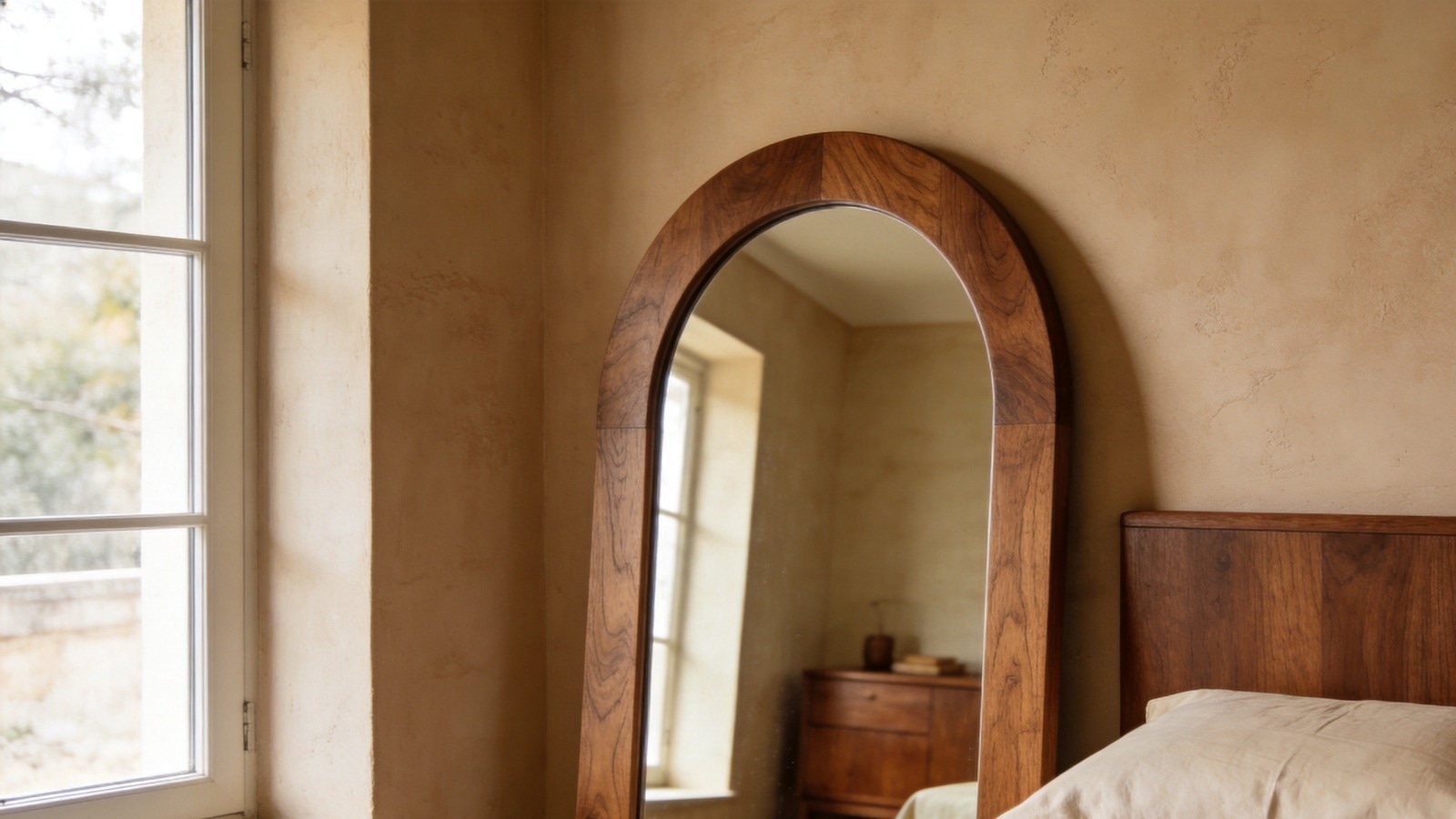
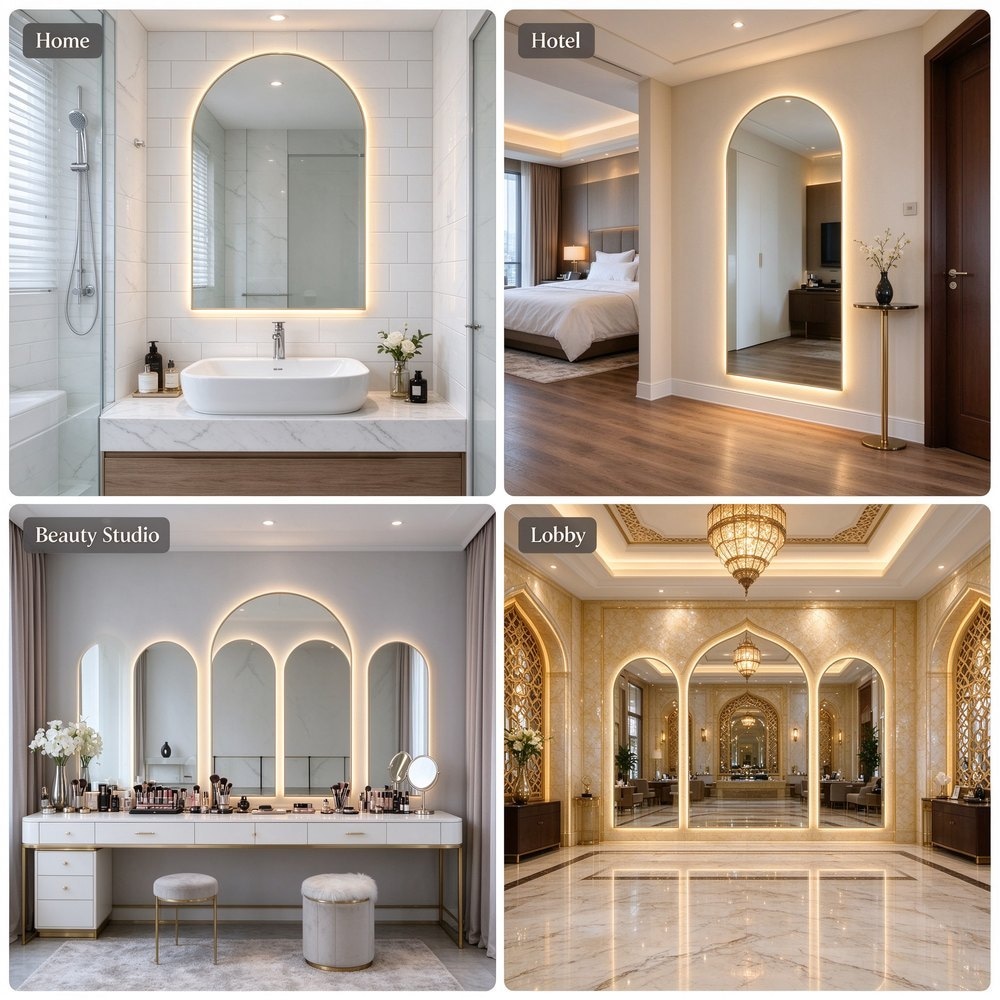
Silhouette. Round, arched, shield, softly irregular, framed or frameless, leaning or hung.
The photograph usually shows the shape clearly and hides the stand, the cleat, or the fact that the thing is resting on a console. Ask.
A leaning mirror and a wall-mounted mirror can be the same glass and a completely different product.
Proportion. This is where mood boards lie hardest. A mirror styled above a narrow console in a two-metre alcove looks monumental. The same diameter on a four-metre hotel wall vanishes.
Before any size is quoted, get the wall width, the ceiling height, and the height of whatever sits beneath the mirror. Two numbers, and half the arguments disappear.
Tone. Champagne, antique brass, warm bronze, matte black, raw-edge polished glass. In a JPEG shot under 2700K bulbs, several of these are indistinguishable.
Finish consistency across a run is a sampling conversation, not a photo conversation — especially when frames come from more than one batch.
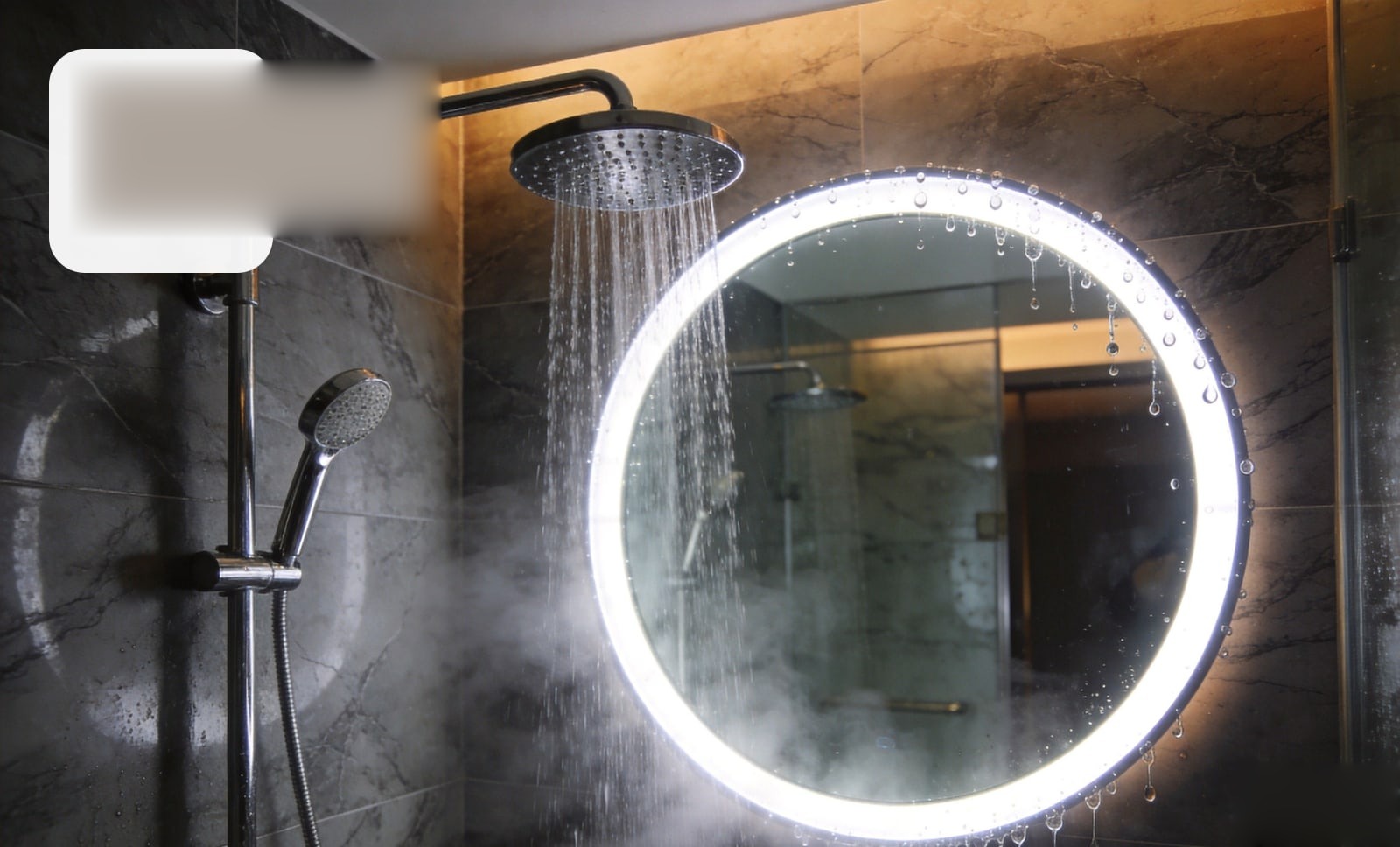
How it behaves in light. A backlit panel, a plain reflective face and a heavily decorated frame read three different ways in a product image and three more ways in a real room.
If the piece is headed for an e-commerce listing, the lighting behavior belongs in the brief from day one, not in post-production.
Why do decorative mirror and eye mirror need different briefs?
Because "eye mirror" arrives meaning three different things, and none of them is the same order.
A decorative mirror is the mood-setter. Its brief is generous — shape, frame, finish, scale — and its hard constraints are mostly proportion and finish consistency.
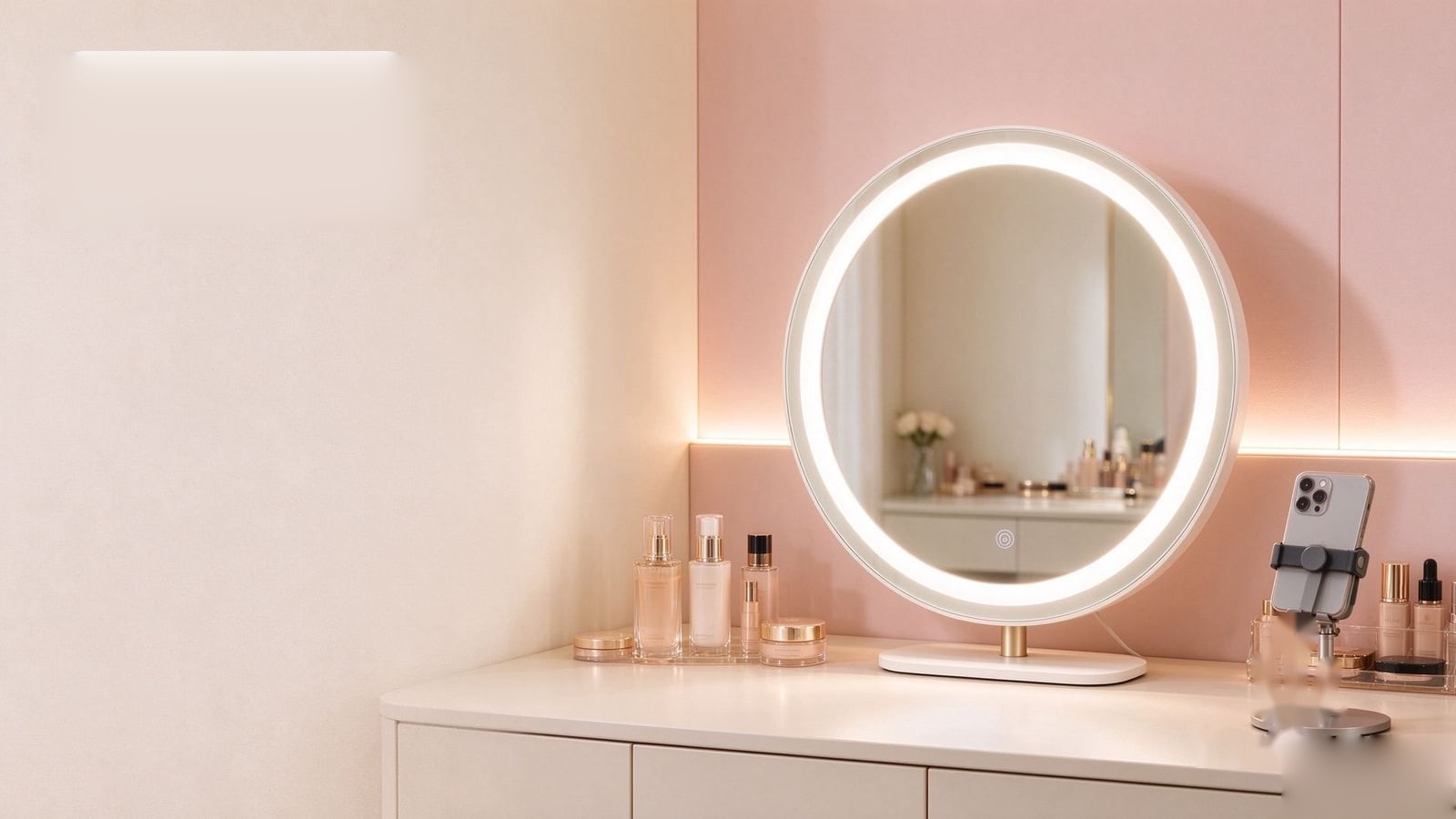
An eye mirror is harder to pin down. In folders we have seen it used for the hero piece the eye lands on first, and for a small standing or arm-mounted magnifying mirror.
It also shows up for a distinct oval or eye-formed panel. Three meanings, three products — so before a quote makes sense, four questions need answers:
- Standing or mounted?
- Fixed or pivoting?
- Magnified or plain?
- Framed or polished edge?
Two buyers can use one phrase and mean two products, and neither is being difficult. Write the answers into the PO and the ambiguity costs nothing.
Where does "luxury" get expensive?
In the frame, the edge, the back, the hardware and the carton — rarely in the glass.
Frame consistency across a run is the classic one. Corner joints are another. Then edge polishing, the back panel, the mounting hardware, and packaging that survives a container and a courier.
| Where the cost sits | What it decides | What to ask for |
|---|---|---|
| Frame | Species, profile, corner joints | Finish sample from the actual batch |
| Edge | Polish grade, raw-edge work | Edge spec on the drawing |
| Back panel | Safety film, backing | Backing spec in writing |
| Hardware | Mounting method, cleat depth | Anchor schedule for the wall |
| Carton | Container and courier survival | Pack test before the first pallet |
Buyers who price a luxury program on the reflective surface alone are usually the ones re-quoting after the first pallet lands.
A fair share of the returns we hear about trace back to mounting and cleaning, not to the mirror face itself. If the mood board implies "floating," somebody has to decide what holds it on the wall.
What commercial frame does the program fit into?
A 50-piece minimum and a 15–25 day production window, with OEM and ODM both standard.
Our minimum order is 50 pieces, and production runs 15–25 days. We build to OEM and ODM briefs, our mirrors carry CE and ETL certification, and our regular markets are North America and Europe.
Our three main lines are LED smart bathroom mirrors, hotel custom mirrors and makeup mirrors — which covers a surprising amount of what a styled interior shot implies.
If your mood board holds six looks, you do not necessarily need six runs. You need a conversation about which two or three carry the assortment, and which are variations on a theme.
That conversation is cheaper before the sample than after it. Here is the checklist we send before a folder leaves the buyer's desk:
- Wall width and height, plus what sits under the mirror
- Mounting intent: wall-mounted, leaning or standing
- Standing mirrors: fixed or pivoting, magnified or plain
- Finish reference — a physical sample beats a screenshot every time
- Destination market, so certification and plug requirements are settled early
- Which piece is the hero, and which are supporting cast
Where do these projects usually slip?
Not in the glass — in the gaps between what was photographed and what was written down.
A size agreed over email without wall dimensions. A finish chosen from a phone screen. A hero piece and a filler piece briefed as if they were the same product.
Fix those three and most of the drama never happens. Get the translation right and the rest is arithmetic — a 50-piece minimum, a 15–25 day window, and a spec that says what the photograph meant.
常见问题 → FAQ
Can you produce a decorative mirror to our own dimensions and finishes?
Yes. We work on both OEM and ODM terms, so you can bring a full drawing or bring a mood board and let us propose the construction. Our minimum order is 50 pieces.
What is the smallest order for a custom eye mirror?
Our published minimum is 50 pieces. If your eye mirror design sits inside a larger decorative mirror program, raise it at the quoting stage so the whole order is structured before anything is confirmed.
How long does a custom mirror order take?
Production lead time is typically 15–25 days. Sampling and approval sit alongside that window rather than inside it, so confirm your actual calendar with your quote rather than assuming the window covers everything.
Do your mirrors carry CE and ETL certification?
Yes — both CE and ETL. That matters if you are shipping into the European Union or North America, and it is worth confirming at the brief stage rather than after the cartons are sealed.
Which markets do you ship to?
North America and Europe are our regular destinations. If your project sits outside those regions, say so early — the destination changes packaging and compliance decisions long before it changes the mirror.
Author: Yucron Content Team | Company: YuCron (驭辰科技), Shahe, Hebei, China Last updated: 2026-10-25 Data sources: YuCron company profile, certifications list and manufacturing capabilities pages (yucron.com, accessed 2026-10). Scope note: Commercial terms (MOQ 50, 15–25 day lead time) reflect YuCron's published terms as of October 2026. Confirm current terms in each quotation.
Reference & Standards
- Reference note: Mood-board sourcing benefits from design history, as the V&A mirror collection shows (view)