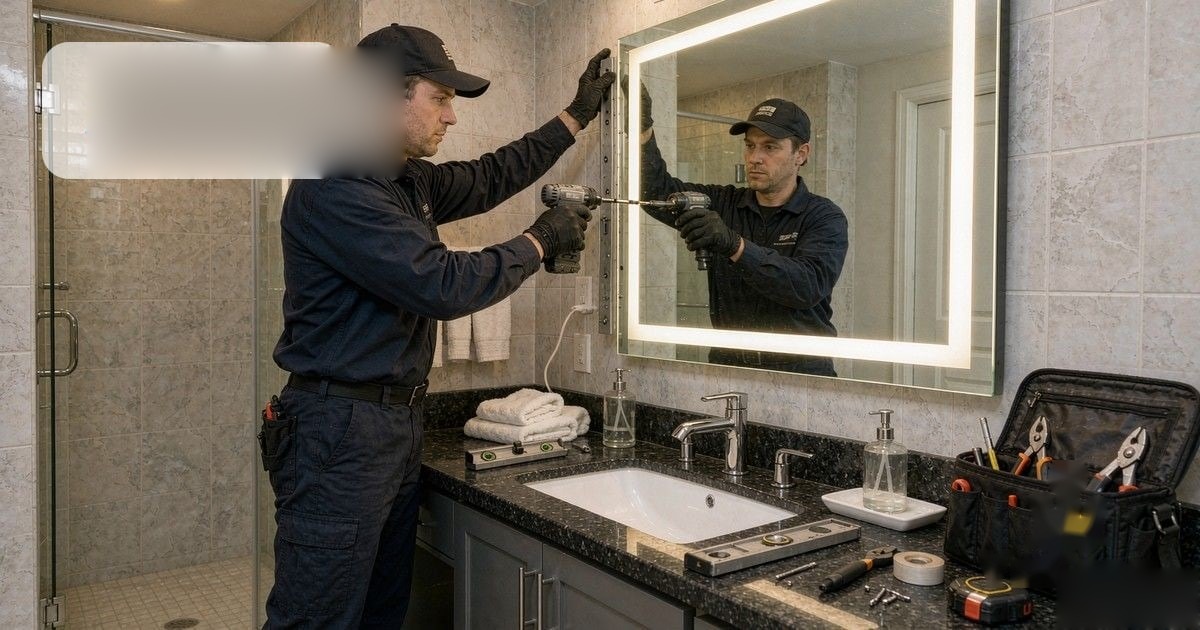
As real estate developers, hotel groups, and interior contractors across North America, Europe, and the Middle East upgrade their property portfolios, bathroom design has shifted from purely functional spaces to experiential wellness zones. Among all architectural fixtures, backlit smart LED mirrors have emerged as the defining centerpiece of high-end hotel guest rooms and luxury residential developments. For the spec-by-spec breakdown of hotel mirror buying, see our hotel bathroom mirror project guide.
The shift is visible in procurement documents, not just showrooms. A growing share of hospitality RFQs now list lighting quality, touchless controls and wet-area ratings as mandatory line items rather than optional upgrades. For wholesalers and project suppliers, understanding what specifiers actually check — and what the mirror's lighting architecture does to the guest experience — is the difference between winning a portfolio contract and quoting into the void.
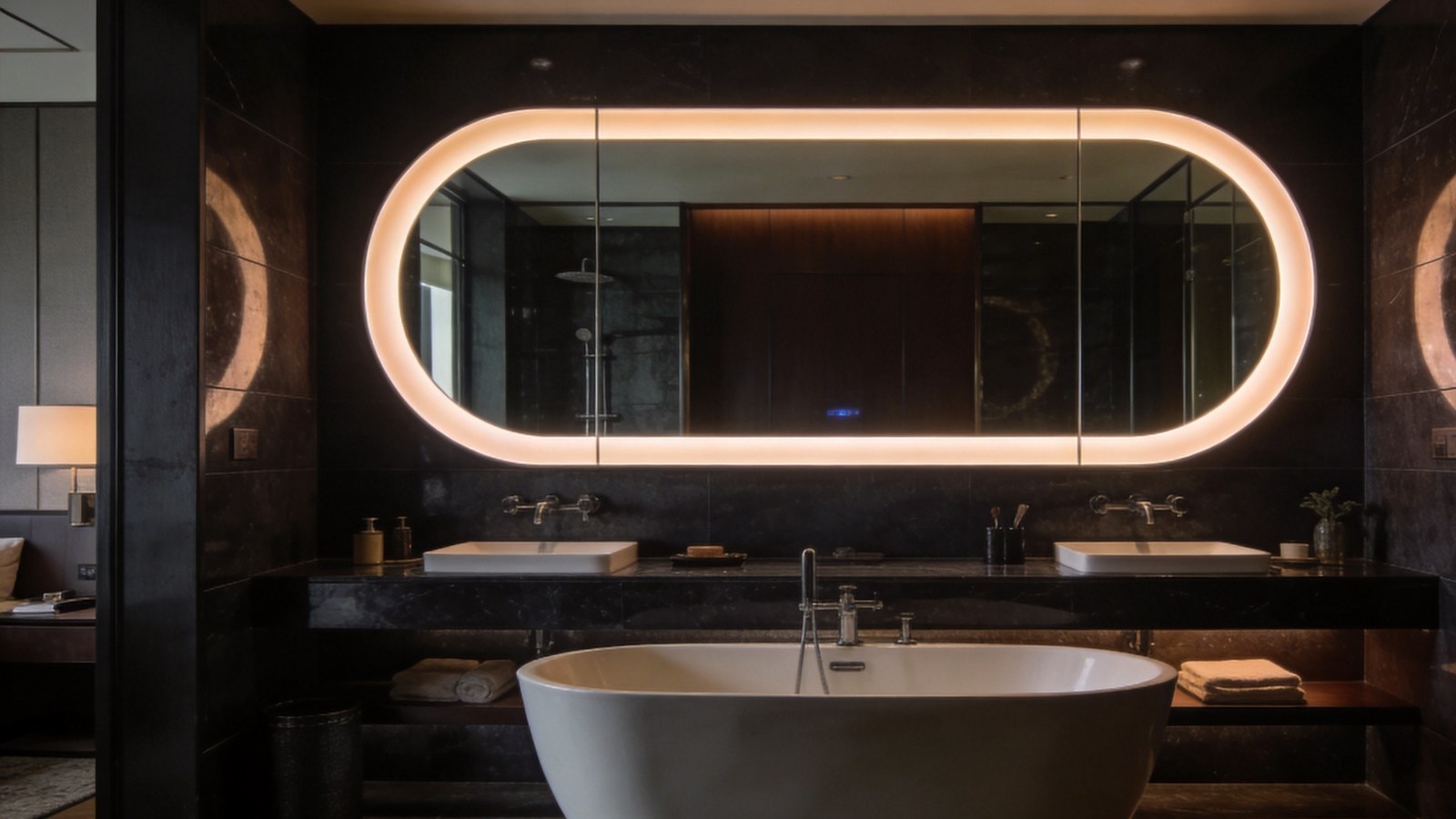
Key Drivers Behind the Surge in Smart Mirror Adoption
Specifiers and procurement managers are prioritizing advanced smart mirrors due to several distinct functional and aesthetic advantages:
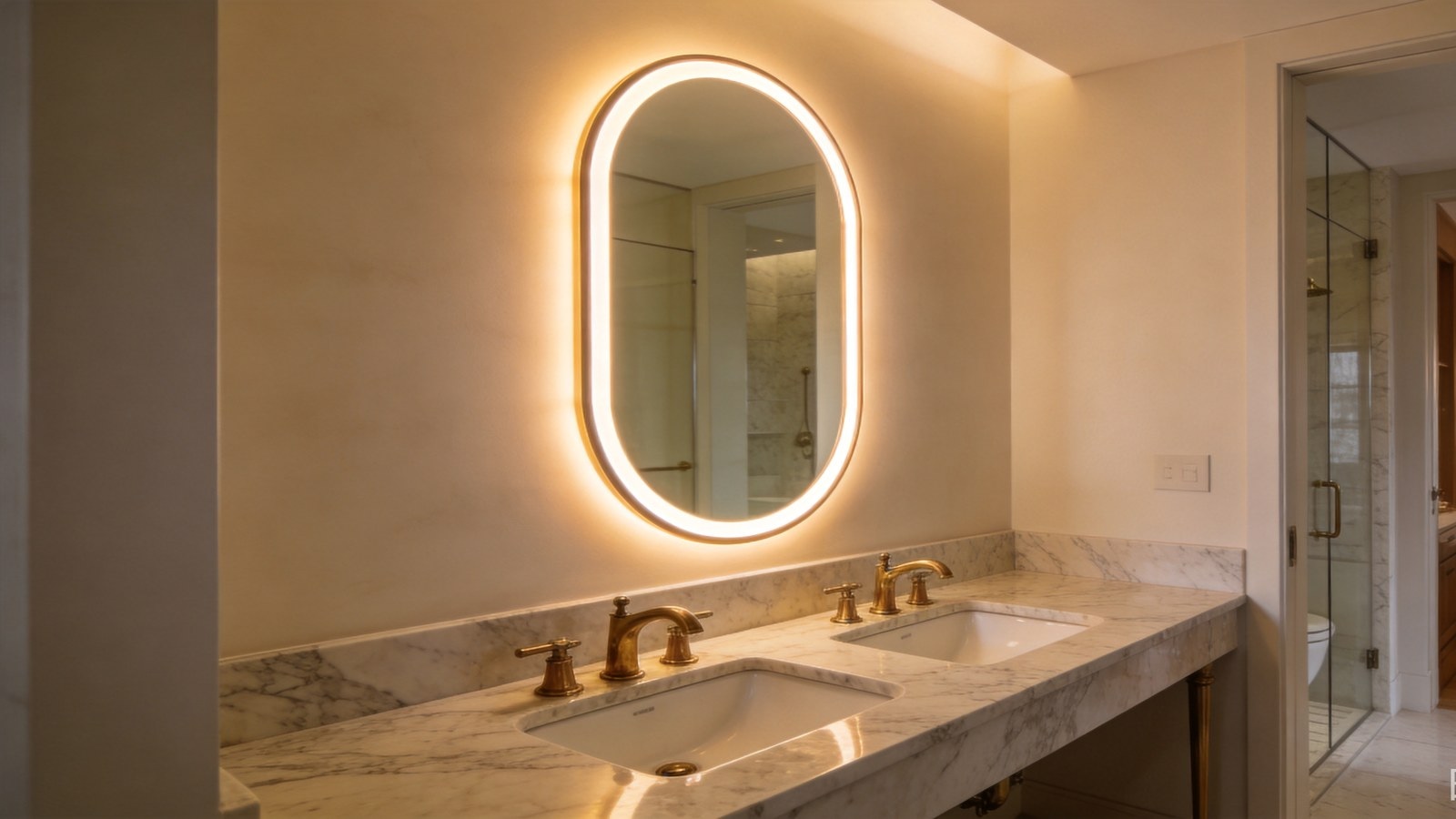
- Immersive Ambient Illumination: Dual-lighting systems (front-lit and backlit) create layered, hotel-grade ambiance while reducing the need for excessive secondary ceiling lighting. In a guest bathroom, the mirror becomes the primary light source — evenly diffused across the face for grooming, with a warm glow that reads as luxury rather than utility. Developers increasingly treat it as a design element that photographs well in listing imagery and sells the room before a guest ever arrives.
- Energy Efficiency and Longevity: High-efficiency LED strips provide over 50,000 hours of continuous operation, significantly lowering long-term maintenance and replacement costs for hotel operators. Over a seven-to-ten-year renovation cycle, a mirror with a driver that outlives the room eliminates service calls, spare-part logistics and the downtime of taking a bathroom out of inventory. For a 200-room property, that math runs into five figures of avoided maintenance cost.
- Touchless Hygiene and Smart Convenience: Integrated infrared motion sensors and touch-free demister pads align perfectly with post-pandemic hygiene standards and modern user expectations. Guests never touch a wet switch; the demister clears the pane before the first use; and motion sensing removes the guesswork of finding a control in a dark bathroom. For housekeeping, fewer touch surfaces means less to sanitize between turnovers.
Backlit vs Front-Lit vs Plain: What the Spec Sheet Really Compares
The lighting architecture decides how the mirror performs — and how it looks at 7 a.m. and midnight. Buyers comparing quotes should ask which architecture the unit uses:
| Lighting type | Light distribution | Typical use | Specifier notes |
|---|---|---|---|
| Backlit (edge-lit glow) | Even panel light across the face | Hotels, luxury residential | The premium choice; lights the face, not the wall |
| Front-lit (bezel LED) | Bright ring, darker center | Value bathrooms | Cheaper; visible LED line can read as harsh |
| Plain (no LED) | Reflected ambient only | Utility spaces | No grooming light; lowest cost, lowest appeal |
Backlit units carry a higher build cost but a measurably stronger guest response. On renovation programs where the mirror is the only lighting upgrade in budget, specifiers routinely pick backlit to get the maximum perceived value per dollar.
A Project Buyer's Procurement Checklist
Send this alongside any hospitality or residential RFQ — it is the same list we hand project accounts before quoting:
- Lighting architecture: backlit or front-lit, and the LED strip brand if specified
- Color temperature: 3000K / 4000K / 6000K tri-color with touch dimming — or fixed, if the property standardizes one setting
- Wet-area rating: IP44 minimum for over-basin; IP65 for shower-adjacent and jet-cleaned commercial baths
- Anti-fog: full-surface heating pad, with wattage stated in writing
- Glass: 5mm copper-free silver, shatter-proof film on the back pane
- Batch consistency: CCT binning tolerance in writing, so every room matches
- Controls: touch, motion or both; memory function so settings persist
- Certifications: ETL/UL for the US, CE/RoHS for Europe, GCC documentation for Gulf projects
- MOQ and phasing: can the factory hold spec and price across two or three release waves?
- Service access: can a driver swap be done without full demounting?
A factory that answers all ten line by line, with cert numbers and written lead times, is a project supplier. Anything less is a listing.
Meeting Strict Regional Building and Energy Codes
Supplying fixtures for large-scale international commercial projects requires compliance with rigorous electrical and environmental regulations. Reliable manufacturing partners ensure that every mirror meets regional safety benchmarks:
| Market | Key certifications | Practical notes |
|---|---|---|
| North America | ETL or UL; FCC for wireless | Retail and hotel groups require listed certification on the full unit |
| Europe | CE (DoC), RoHS; LVD/EMC reports | UK runs UKCA and its own plug geometry post-Brexit |
| Middle East / GCC | CE base + SASO/SABER for Saudi, GSO across the Gulf | 220–240V, Type G plug dominant; dust-plus-humidity favors IP65 |
Beyond certification, energy compliance is increasingly part of the spec: high-efficiency drivers with standby consumption below regulatory thresholds, and LED output binned to keep color temperature consistent across every unit in an order. Category newcomers should start from the smart mirror wholesale sourcing guide.
Why Specifiers Choose YuCron for Hospitality & Residential Projects
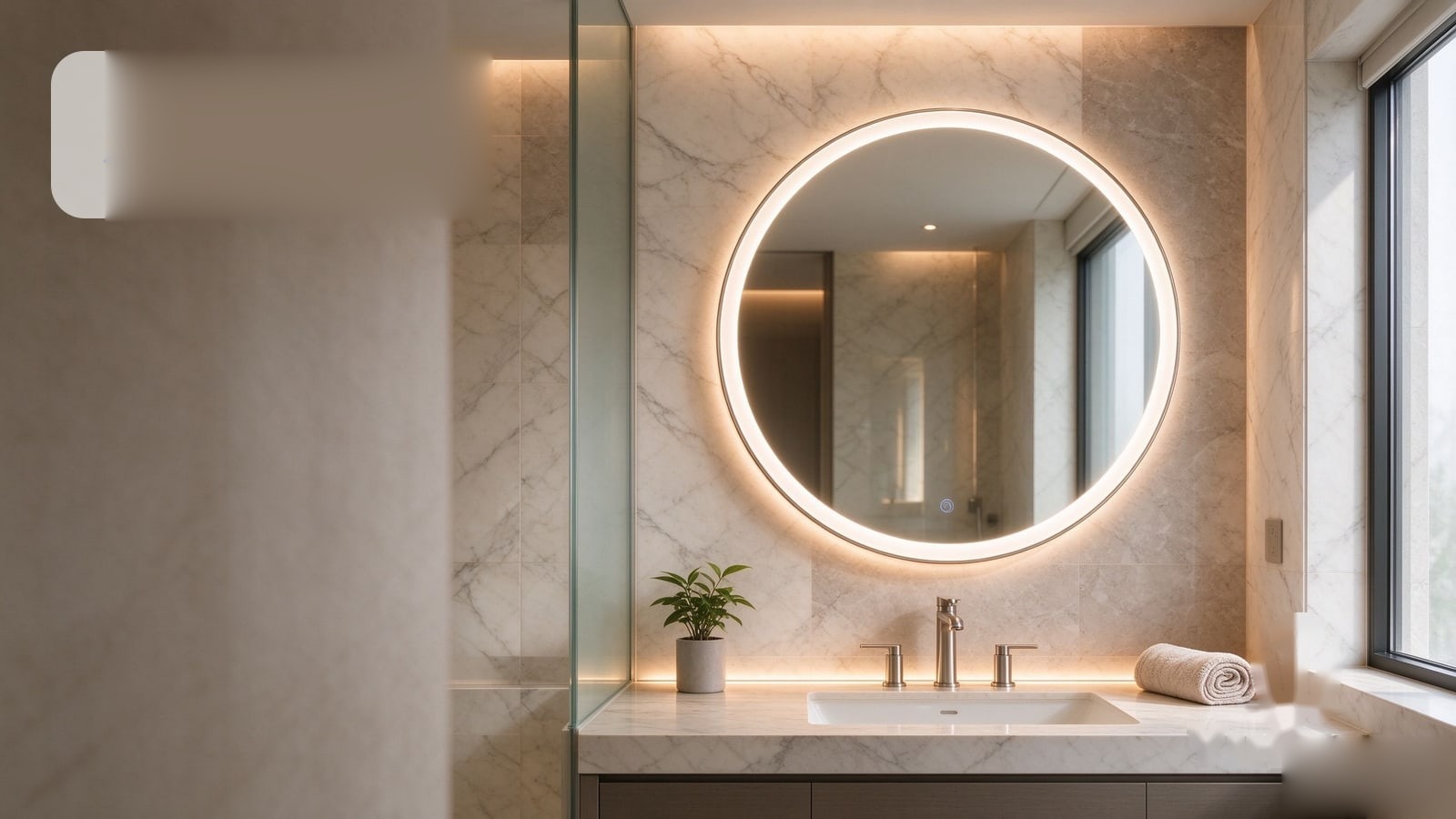
YuCron manufactures smart and LED mirrors in Shahe, Hebei, China with a 20,000 m² owned factory, 500,000 pcs annual capacity and 30+ patents and designs. For project work specifically, three things matter: the round line (YC-SM-E0024, 50–90 cm diameters, 21 mm aluminium frame) and the frameless backlit line (YC-SM-E0025, IP54 back panel, 800×600 to 1200×700 mm) cover residential and commercial zones from one catalogue instead of three vendors; OEM/ODM depth handles custom diameters, logos and up to 50 color-and-size combinations; and the factory answers in English within four working hours with real pricing and certification files.
From OEM/ODM customization to certified project volumes, the factory handles both — and the 15–25 day lead time at MOQ 50 lets developers phase rollouts floor by floor.
What's Next: 2026–2027 Trends Specifiers Are Watching
Three movements are shaping the next spec cycles. Wellness bathrooms — steam rooms, wet areas and spa-style finishes — push wet-area ratings and humidity-proof construction up the priority list; expect IP65 to become the default ask rather than a premium. Design-led residential is importing hotel language into homes: frameless backlit rounds, warm brass and black finishes, and lighting that adapts to makeup, evening and reading modes. And energy-conscious procurement is tightening: buyers now ask for driver efficiency data, standby consumption and LED binning tolerance in the same sentence as the price. Projects that spec for these three today will be quoting against them tomorrow, and the factory that documents the answers wins the order.
Why Certification Files Decide Project Tenders
On hospitality tenders, the certification file is often the tiebreaker between two otherwise identical quotes. A verifiable ETL or UL number for the US, a CE declaration naming the exact model, and SASO-aligned documentation for Gulf projects turn a price discussion into a compliance discussion — which is where an experienced manufacturer stops competing on margin and starts competing on proof. Wholesalers who keep the complete file for every model they quote close more tenders, because the specifier's legal exposure is reduced before the first sample arrives.
FAQ
Why are backlit smart mirrors preferred in hotel projects? Backlit architecture lights the face evenly as a panel, which is what vanity lighting and designer specs call for. Front-lit leaves a bright ring with a dark center that reads harshly in a premium room.
What IP rating do guest bathrooms need? IP44 covers over-basin residential placements. For shower-adjacent mounts, wet rooms and jet-cleaned commercial baths, IP65 is the sensible floor — sealed against water jets, not just splashes.
Do residential buyers need the same specs as hotels? Mostly, with lighter rigor. Residential buyers care about dimming, color temperature and anti-fog; hotels additionally demand batch consistency, service access and commercial cleaning resistance.
How long does a project order take? 15–25 days production on stocked formats after spec confirmation, plus ocean freight to the destination port. Custom sizes or logos add time — plan around the designer's approval date, not the reorder cycle.
Can one mirror line cover both hospitality and residential? Yes. A shared product family, with IP54 stock builds and IP65 enclosures quoted to order, covers both zones with one tooling investment and one maintenance parts set.
What MOQ should a project buyer expect? MOQ 50 on stocked bathroom mirror lines. Full property rollouts of 100–300 units get the best unit price, with the real constraint being one production run so color temperature and finish stay identical.
Partner with YuCron for Commercial Project Success
YuCron collaborates closely with global project contractors, wholesalers, and architectural brands, delivering customized smart LED mirror solutions backed by robust factory capacity and stringent quality assurance.
Planning an upcoming hospitality or residential project? Contact the YuCron project team today to discuss bulk quotations, custom architectural blueprints, and sample coordination.
Reference & Standards
- Reference note: Ingress-protection claims on backlit units are read against IEC 60529 (view)