Freight Questions to Settle Before a Mirror Order
We quote a lot of mirrors, and almost every brief that reaches us opens with a shape. A gym mirror wall for a fitness studio. An arch mirror for a hallway niche. Then, depending on where the buyer sits, the subject line says ayna or espejos grandes and nothing else. Shape gets all the attention in the first email. Freight gets the last five minutes of the third call — usually after someone has already promised a delivery date to a client.
That order of events is backwards, and it costs money on both sides of the water.
This is not another piece about glass thickness or frame profiles. It is about the handling profile of an order: how the physical outline of the panel collides with the quote before anything is cut.

Why do most buyers sequence the job wrong?
The textbook sequence is design, quote, produce, ship — the working sequence has a handling check between design and quote.
For anything that leaves our floor — LED smart bathroom mirrors, custom work for hotel projects, makeup mirrors — the working sequence looks more like design, handling check, quote, produce.
One extra thought in week one usually saves a pallet in week six. Why? Because a mirror is not a box of textiles.
Its cost per cubic metre is dominated by air and protection, not by weight.
Two orders of the same value can leave the yard as three crates or as nine, and the difference is decided by dimensions and shapes that were locked in on day one.
What handling profile does each search term carry?
The four phrases arrive from very different places — the words differ, the physics do not.
| Search term | What it usually signals | Where it bites later |
|---|---|---|
| gym mirror | Multiple wall panels, matched set | Consistency across panels; one broken piece is hard to replace alone |
| arch mirror | Non-rectangular outline, feature piece | The crate is square, the product is not — void space and curve support |
| ayna | General "mirror" query, size unstated | Brief is thin; everything still has to be asked |
| espejos grandes | Size-led request, big panels | Cube, pallet count, and what fits through the customer's door |
Gym mirror — the wall that arrives as a set. Gym walls are the classic matched-set job. Six panels, ten panels, sometimes more, all supposed to read as one continuous surface under hard overhead lighting.
Any variation in coating or edge work shows up instantly in a gym — bright, unforgiving light and no furniture to break the eye line.
The freight consequence is simple and buyers keep missing it: a set stays useful while it stays a set. Damage one panel in transit and you are not replacing a mirror, you are re-matching a wall.
This is why we push customers toward deciding the panel count and the spare strategy at the quotation stage rather than after the crate lands.
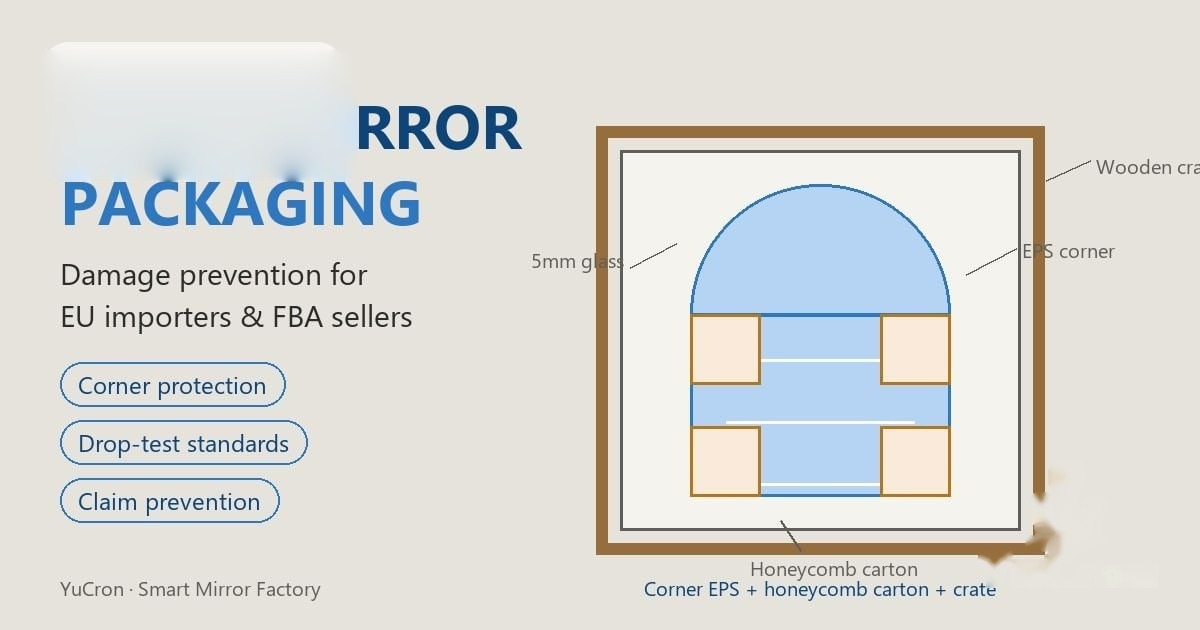
Arch mirror — the curve fights the carton. An arch is a rectangle minus two corners. Crates are still built rectangular, because that is what stacks and what carriers rate.
So a run of arch mirrors can look efficient on paper and then cube out badly in reality — a lot of paid air around the shoulders of each piece.
Then there is support. A flat panel can be braced across its face. A curve needs thought, because you do not want load sitting on the part that gives the piece its character.
When a buyer sends a photo instead of a drawing, this is the first thing we cannot answer. A photo shows the look, not the radius — and the radius decides how the piece is packed and hung.
Ayna and espejos grandes — one word says nothing, the other says too much. Turkish buyers often open with ayna, which simply means mirror. It is a category, not a specification.
Spanish-speaking buyers writing espejos grandes have done half our job for us: they have told us the job is size-led.
That flags cube, pallet height and whether the finished piece clears a residential stairwell or a hotel service lift.
Both inquiries land in the same queue. The difference is how many questions stand between the email and a firm price. With ayna, expect a longer exchange.
Send a sketch, a wall dimension and a destination, and you skip two rounds.
Why is the minimum order also a freight number?
Because order quantity and shipment size are different things decided by the same number.
Our minimum order is 50 pieces, and our standard production window is 15–25 days. Buyers read those two numbers as commercial terms. They are also logistics terms.
Fifty makeup mirrors and fifty gym mirror panels are the same order quantity and completely different shipments. One fits on a handful of pallets; the other can be a small container on its own.
Both take the same production window on our side — and then the ocean leg begins, which is not our clock and never will be.
When a North American or European buyer works backwards from an install date, we would rather they subtract the sea freight first and argue about the factory window second.
Where do CE and ETL sit in the freight conversation?
Illuminated product changes the box — drivers, wiring and connections have their own packing logic and documentation.
A CE mark serves our European customers; ETL serves the North American side. Both belong to the electrical portion of an LED smart bathroom mirror.
That means the shipment contains more than glass — there are drivers, wiring and connections that have their own packing logic and their own documentation.
For unlit decorative pieces, that layer disappears and the freight conversation gets simpler. Tell us on the first line which of the two you are buying.
We have had quotes restarted because a buyer assumed "mirror" meant one thing and the purchase order meant the other.
What do we ask before a mixed order gets priced?
Not a form — a conversation, and it runs roughly like this.
- Where is the crate going — port, city, or straight to a site?
- Which pieces are illuminated and which are not?
- Are the gym mirror panels and the arch mirror pieces one run or two?
- Does the whole order share one finish, or is it a collection in several finishes?
- Is this your brand on the product and the packaging, or ours?
That last question matters more than buyers expect. OEM and ODM work is routine for us, but branding touches packaging, and packaging touches cube.
A printed carton with different artwork for six sizes is not the same shipment as six plain cartons.
Which four leaks show up repeatedly?
Over-protection, mismatched pallet heights, single-piece reorders and skipped door measurements.
Over-protection. Buyers sometimes specify packaging so heavy that the freight cost climbs past the value of the protection.
There is a balance point, and it is not the same for a hotel corridor mirror as for a container of small makeup mirrors.
Mismatched pallet heights. Mixed orders stacked unevenly waste vertical space and invite damage at the corners.
Single-piece reorders. Replacing one panel from a matched gym wall months later is possible; matching it perfectly is another matter. Plan the set, not the piece.
Skipping the door measurement. We have quoted beautiful espejos grandes that could not physically enter the room they were designed for.
Measure the lift, the stairwell and the door before the drawing is approved.
If your subject line says gym mirror, arch mirror, ayna or espejos grandes, we will answer. Just add three things: a dimension, a destination and a finish.
Those three lines turn a search term into a quotation, and they turn the freight conversation from a late surprise into a line item you planned for.
常见问题 → FAQ
What is your minimum order quantity?
50 pieces. It applies to a run, so a mixed order combining gym mirror panels, arch mirror pieces and standard bathroom models can be arranged as one production batch, subject to the shapes involved.
How long does production take?
Our standard window is 15–25 days. Sea freight and inland delivery sit outside that figure, so build them into your schedule separately when you are working back from an installation date.
Why does an arch mirror cube out worse than a rectangle?
Because the crate is rectangular and the product is not. A run of arches leaves paid air around the shoulders of each piece, and the curve needs support that a flat panel never asks for. The radius decides the packing, so it belongs in the drawing rather than a photo.
Can one panel of a gym mirror wall be replaced later?
It can be replaced; matching it perfectly is another matter. Coating and edge work vary between runs, so the spare strategy belongs in the original order. Decide the panel count and the spares at the quotation stage, not after the crate lands.
What three lines turn a search term into a quotation?
A dimension, a destination and a finish. Those three answers settle the handling profile, the compliance route and the packing plan — everything else follows from them.
Author: Yucron Content Team | Company: YuCron (驭辰科技), Shahe, Hebei, China Last updated: 2026-10-25 Data sources: YuCron company profile, certifications list and manufacturing capabilities pages (yucron.com, accessed 2026-10). Scope note: Commercial terms (MOQ 50, 15–25 day lead time) reflect YuCron's published terms as of October 2026. Confirm current terms in each quotation.
Related Yucron Products
- 3-way full-length mirror for studio use
- rounded-corner metal full-length mirror
- gym mirror wall specification guide
- Reference note: Transit-test protocols for mirror cartons are maintained by ISTA (view)