Specifying a Gym Mirror Wall That Survives Weights
Almost no gym mirror enquiry reaches us labelled that way. It arrives as a phone photo of a fitness studio wall, a width measured by pacing the floor, and one line: same look, but could it take a wooden mirror frame? A week later someone in Milan writes specchio, and a buyer in Lyon types mirroire. Four vocabularies, one production question.
Below is how those briefs read on the factory side, and the order in which the decisions should actually be made.

Why is a gym mirror brief a safety brief?
Because people lift heavy objects near this glass — bars, plates and a wall ball involved.
Start with the obvious thing people skip: this is actual proximity, not decorative proximity.
So a gym mirror panel is specified differently from a bathroom mirror or a hotel corridor mirror.
In most fitness briefs we see, the glass lands between 4 mm and 6 mm, and every panel carries a safety backing film bonded to the rear face so a break holds together.
When that film is missing on one panel out of nine, the whole delivery gets rejected at site.
We have watched that happen to a competitor's shipment, and it is an expensive way to learn a cheap lesson.
Where the mirror meets the floor matters too. Skirting, rubber gym flooring and a 20 mm shadow gap are three different bottom edges. Decide which one before the glass is cut, not after.
How should panels be sized and jointed?
From the handling limit first — doorway, lift, stair turn — then adjust the joints to land behind racks.
Gym walls run long, often three to six metres of continuous glass. Nobody ships that as one piece, and nobody can carry it up a stairwell either. So the real design work is in the joints.
Two habits worth stealing from experienced installers:
- Set panel widths from the handling limit first, then adjust the joint positions so they land behind racks or between equipment stations.
- Keep joints vertical rather than stacking narrow strips. A 300 mm strip next to a 1200 mm panel reads as a mistake to the eye, even when it was a cost decision.
If the wall is going to be photographed for a membership campaign — and it usually is — walk the room at the height of the mirror's centre line. That is where seams become visible.
| Decision | What it controls | Common failure |
|---|---|---|
| Panel width | Handling through door, lift, stair turn | A panel that cannot enter the building |
| Joint position | Where seams land visually | Seams in the camera line of the campaign photo |
| Bottom edge | Skirting, rubber floor or shadow gap | Edge detail decided after the glass is cut |
| Fixing system | Channel, brackets or adhesive plus mechanical | Hardware list changes once the substrate is known |
Which edges and fixings suit the wall behind?
Frameless gym walls typically use a polished or bevelled edge with mechanical fixings plus adhesive, or a channel system.
Which one you can use depends on what the wall is built from. Drywall with a brittle skim coat behaves nothing like blockwork.
Ask the question early; it changes the hardware list and the installation time. The wall substrate is a site fact, and no drawing overrides it.
Where does a wooden mirror earn its place?
In hallways, vanity walls and dressing areas — not in swinging range of a dumbbell.
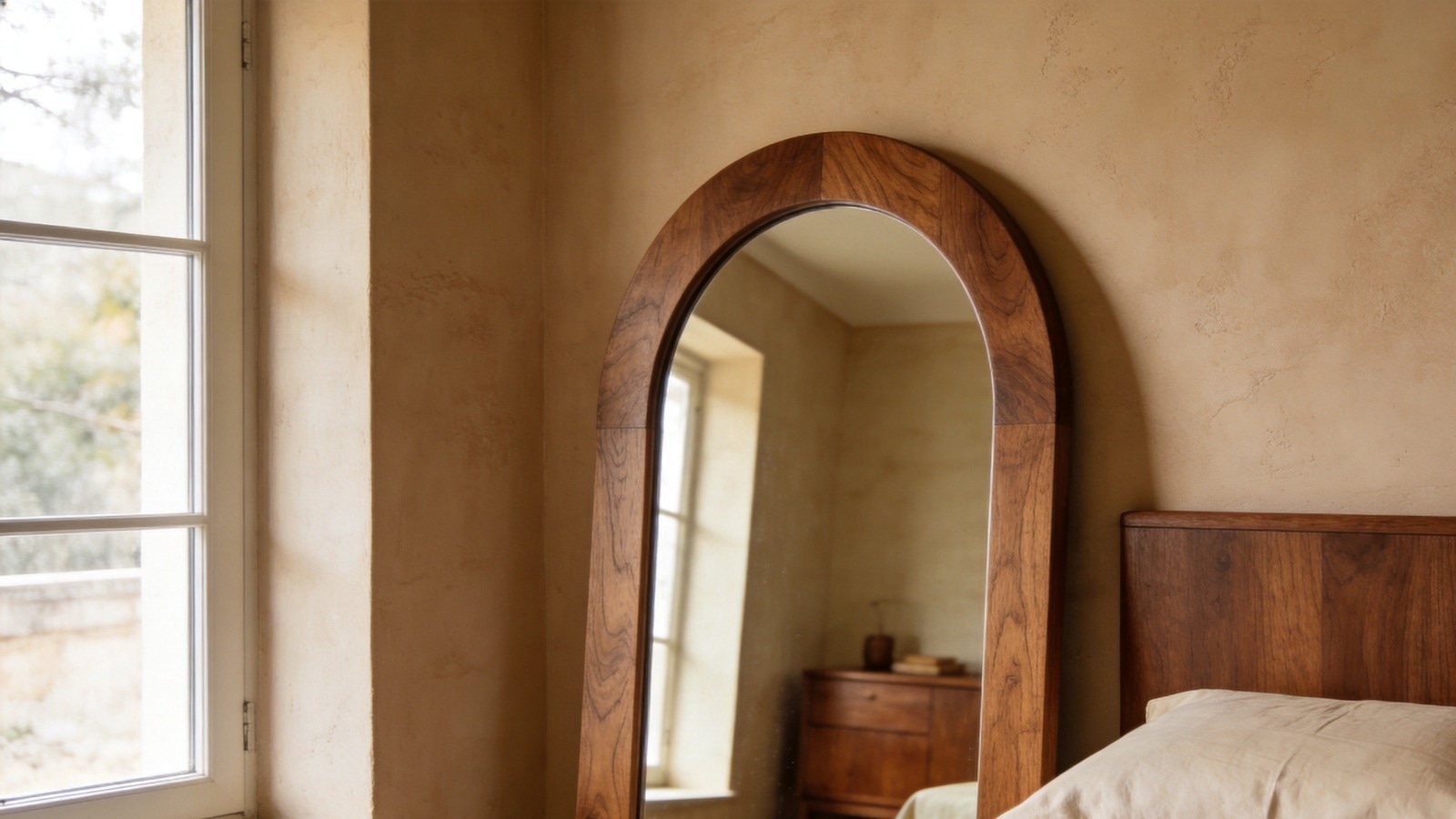
Here is where the wooden mirror request usually comes from: a residential hallway, a hotel vanity wall, a dressing area.
Wood brings warmth, and a timber frame hides the edge of the glass without any polishing cost.
In a fitness room, though, a wooden mirror frame is a harder sell. Frames collect chalk dust and cleaning spray, and the lower rail is exactly where a dumbbell lands.
When a client insists on the look, we suggest one of two compromises: a timber frame above roughly 2.1 m, safely out of swinging range.
Or a wood-effect aluminium profile that gives the same tone with less maintenance.
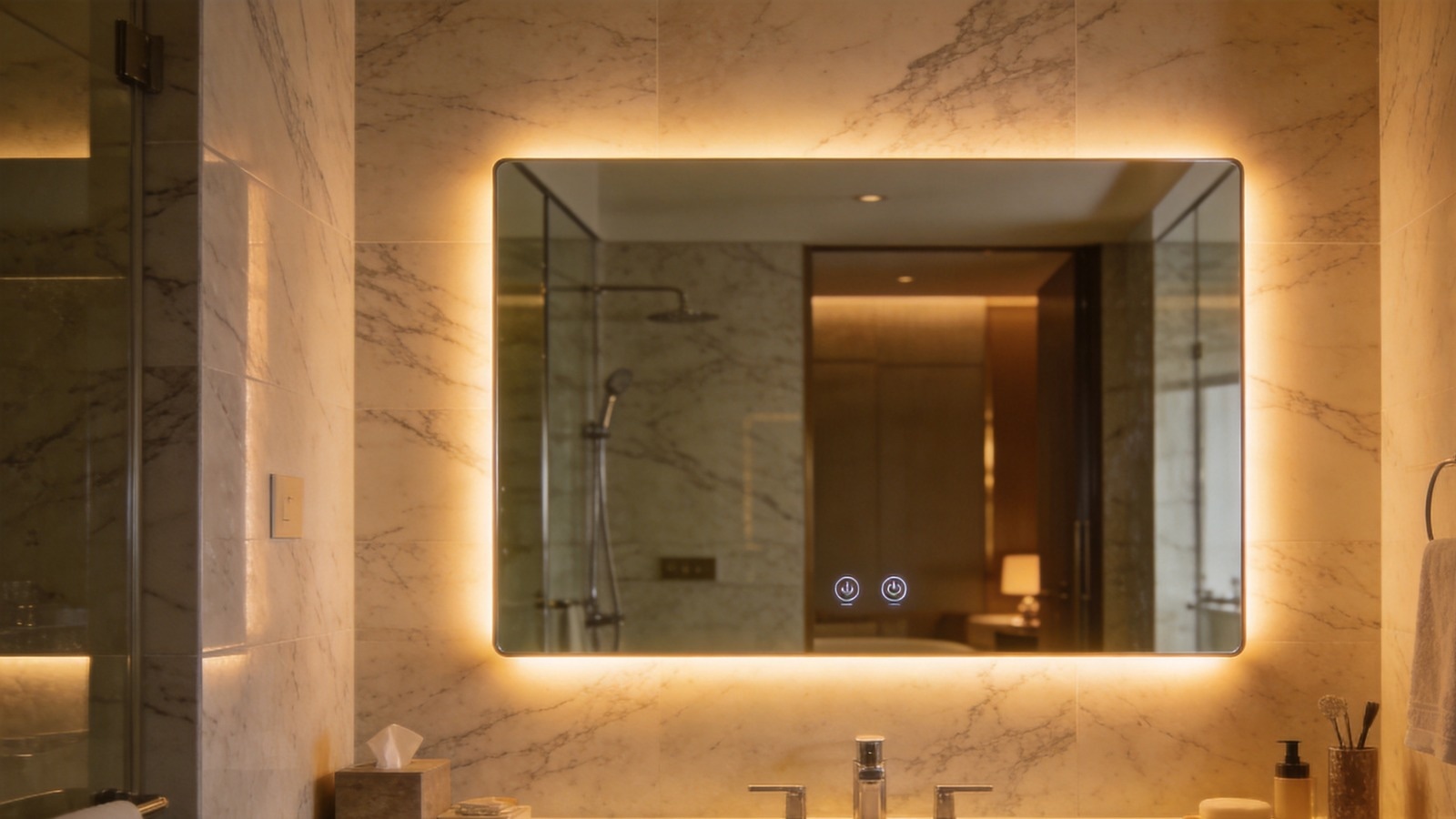
For bathrooms and hotel rooms — the two product families our line is built around, alongside lighted makeup mirrors — a wooden frame is far more forgiving. Just seal the timber properly.
Steam finds unsealed end grain, and a frame that swells in month two is a complaint in month four.
How do specchio and mirroire get resolved?
With a short reply of five questions, sent before any price.
Italian buyers write specchio the way English buyers write mirror. It is a noun, not a product code, and it tells you nothing about size, orientation, lighting or fixing.
The same goes for mirroire. Nine times out of ten it is a typed slip for the French miroir, and the sender wants a decorative framed mirror, sometimes an adhesive panel for a rented flat.
Guessing from the noun alone is how quotes go wrong. What resolves the ambiguity is a short reply with five questions:
- Wall width and height, plus ceiling height.
- Frame: none, timber, or metal profile.
- Lighted or unlit — and if lighted, where the switch and supply sit.
- Wall substrate and preferred fixing method.
- Destination country, quantity, and whether electrical certification is required.
Two of those five — destination and lighting — decide whether the job needs CE marking for Europe or ETL for North America. That single answer can move a quote by more than the glass does.
And "specchio con luce" — a lighted mirror — is a different drawing from an unlit one. Ask for a photo of the existing wall. Buyers almost always have one on their phone.
In what order should the quote sheet be filled?
Purpose, dimensions, frame, fixing, compliance, quantity — in that order.
After enough of these, the sequence stops being optional:
- Purpose first. Gym, hotel room, bathroom vanity, rental flat. The purpose decides the glass and the backing.
- Dimensions second, including the gap at floor and ceiling.
- Frame or frameless third. This is where wooden mirror and gym mirror briefs finally diverge.
- Fixing fourth. Hardware, substrate, and who installs.
- Compliance fifth. CE or ETL where electricity is involved.
- Quantity last, because that is where the commercial conversation really starts.
Custom mirror runs on our line start at 50 pieces per model, with OEM and ODM work both supported.
Production runs 15–25 days once the drawing is signed off, and freight to North America or Europe sits on top of that.
The delay that catches people is rarely the glass. It is the drawing approval.
A buyer who returns a marked-up photo with dimensions written on it in red saves roughly a week compared with one who returns a rewritten spec document.
One more thing worth saying plainly: a gym wall and a wooden mirror for a hotel corridor are not the same purchase.
If both appear in one enquiry, they are quoted, sampled and produced as separate runs — different glass, different edges, different fixings.
Combining them into one shipment is easy. Pretending they are one specification is not.
常见问题 → FAQ
What does mirroire mean?
It is almost always a misspelling of the French word miroir, meaning mirror. In practice, the sender is usually asking about a decorative framed mirror, and occasionally an adhesive panel for a rented wall. Confirm the type rather than assuming.
Is specchio a mirror brand?
No. It is simply the Italian noun for mirror. A brief that says specchio still needs dimensions, frame type, lighting and fixing method before it can be quoted.
Can gym mirror panels and a wooden mirror be produced in the same order?
They can share a shipment, but they are different builds — safety-backed glass with exposed edges versus framed decorative glass. Expect them to be quoted as separate runs, each subject to the 50-piece minimum per model.
What glass should a fitness wall use?
Most gym briefs specify 4–6 mm mirror with a bonded safety backing film, with panel widths set by handling limits. Local building rules override any general recommendation, so confirm the requirement for your site before ordering.
How long does a custom mirror order take?
Around 15–25 days in production after drawing sign-off, plus freight. Certification such as CE or ETL applies where the mirror is lighted, and that should be settled at the quoting stage rather than after the deposit.
Author: Yucron Content Team | Company: YuCron (驭辰科技), Shahe, Hebei, China Last updated: 2026-10-25 Data sources: YuCron company profile, certifications list and manufacturing capabilities pages (yucron.com, accessed 2026-10). Scope note: Commercial terms (MOQ 50, 15–25 day lead time) reflect YuCron's published terms as of October 2026. Confirm current terms in each quotation.
Related Yucron Products
- 3-way full-length mirror for studio use
- rounded-corner metal full-length mirror
- Standards note: US safety-glazing rules sit in 16 CFR Part 1201 (view)