How High Should a Mirror Hang? Height Specs
Height is the first thing a buyer gets wrong on a mirror order, and the last thing anyone notices in a photo.
We build mirrors for importers, hotel projects and retail brands shipping into North America and Europe.
The briefs that come back for revision almost always share one trait: the length was picked from a catalogue page instead of from the wall.
This guide covers long mirrors and espejos grandes, the miroir de chambre brief, and the awkward, genuinely useful case of an asymmetrical mirror.
It looks at what each one changes on the production sheet before anything gets cut.

Why start with the ceiling line, not the product page?
Because a 1,800 mm mirror on a 2,400 mm wall and the same mirror on a 2,700 mm wall are two different products visually, even though the PO says the same thing.
Here's a habit worth stealing from the interior designers we work with.
Before they send us a dimension, they photograph the wall with a tape measure held vertically against it, floor to ceiling, in one frame. No cropping.
Then they mark the baseboard, any outlet, the light switch, the door swing.
Why so fussy? The glass doesn't change. The room does. We have seen buyers approve a sample, then receive a container and discover the mirrors read short and squat in the actual guestroom.
Nothing was defective. The reference photo was a showroom with higher ceilings.
So the first column on our intake sheet isn't width or height. It's available wall height. Everything else argues with that number.
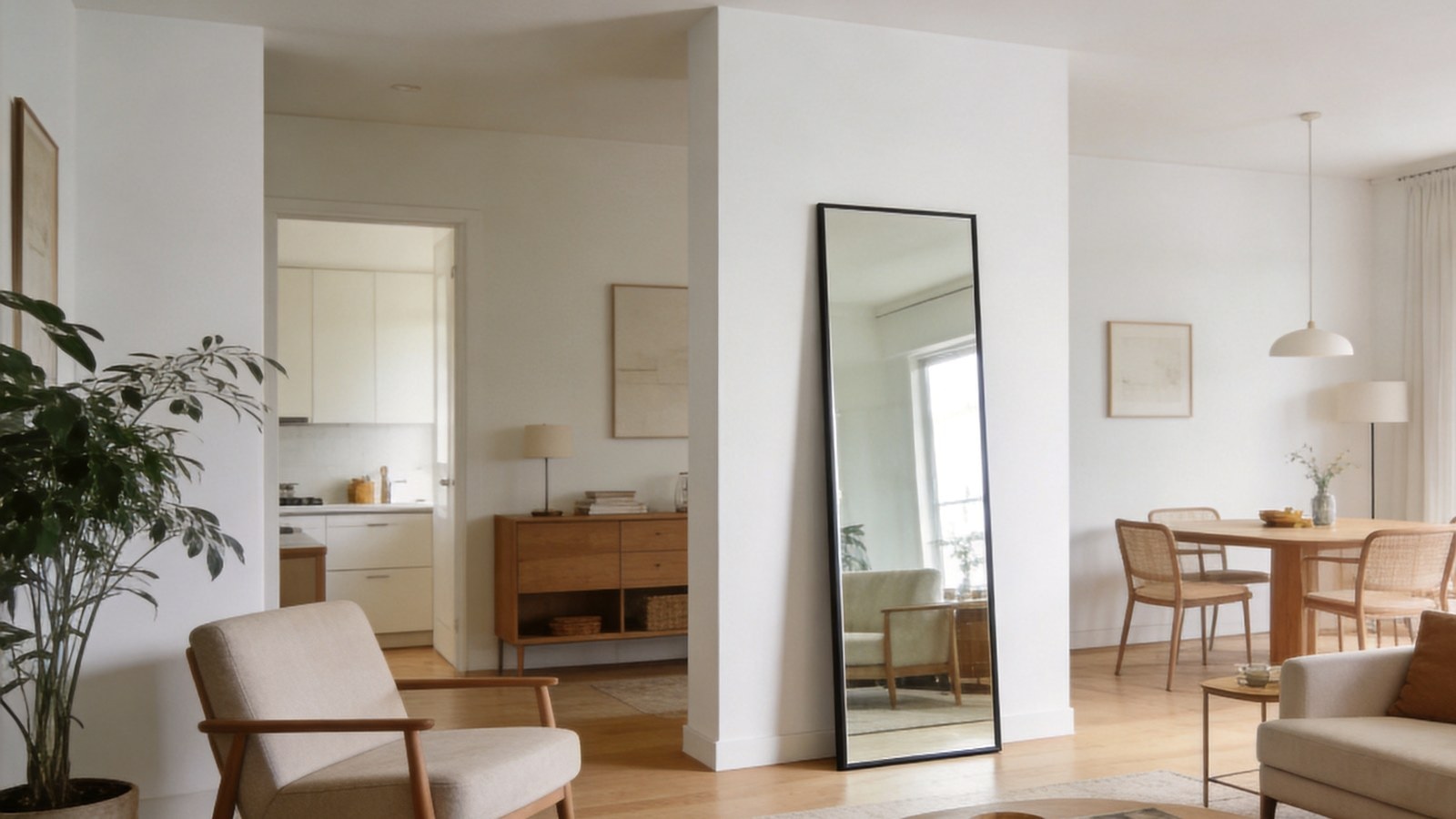
Should a long mirror lean or anchor?
Leaning and anchored are two different products, and buyers sometimes don't know which one they've ordered until the drawing stage.
Leaning. The mirror rests on the floor against the wall, tilted back a few degrees. No wall penetration. Popular in apartments and rental-heavy markets, and in bedrooms where the tenant won't drill.
The catch: a leaning mirror of any real length needs something stopping it from going over — a wall strap, a floor stop, a chain.
We ask about this early, because the answer changes the back of the product, not the front.
Anchored. French cleat, brackets, or a mirror adhesive system depending on size and wall build. Flush, immovable, better for hotels and any space where housekeeping will lean on it.
There's a third case that catches people out: a mirror sold as leaning but specified with a frame deep enough that it stands almost vertical.
It looks fine in a rendering and behaves badly in a corridor.
Ask your supplier which mounting method the frame depth was designed around — and get it in writing on the drawing, not just in the email thread.
The question we ask that most briefs skip
Who cleans it, and how? A 2,000 mm leaning mirror in a hotel room gets wiped daily by someone holding a cloth at hip height.
If the backing or the strap isn't specified for that, you'll hear about it in month four, not month one.
When does espejos grandes really mean wide?
It carries at least three meanings — full-length, wide over-sofa, or a wall set — so we ask: tall, wide, or both?
Spanish-speaking buyers use the phrase for all three, and none of them is the same order. It's not pedantry. A tall mirror and a wide mirror stress different parts of the process.
Tall panels put the pressure on vertical handling — how the piece is lifted, crated, tipped onto a trolley.
Wide panels multiply the number of units per crate and change how the edges are protected in transit.
A buyer who writes espejos grandes and means "2,200 mm wide for a lobby" is ordering something quite different.
The buyer who means "1,900 mm tall for a dressing area" uses the same phrase on the inquiry, but it is not the same order.
If you can't yet describe the piece in millimetres, describe the wall instead. Send the photo. We'll propose the numbers, and you can push back. That conversation costs a day.
Guessing costs a container.
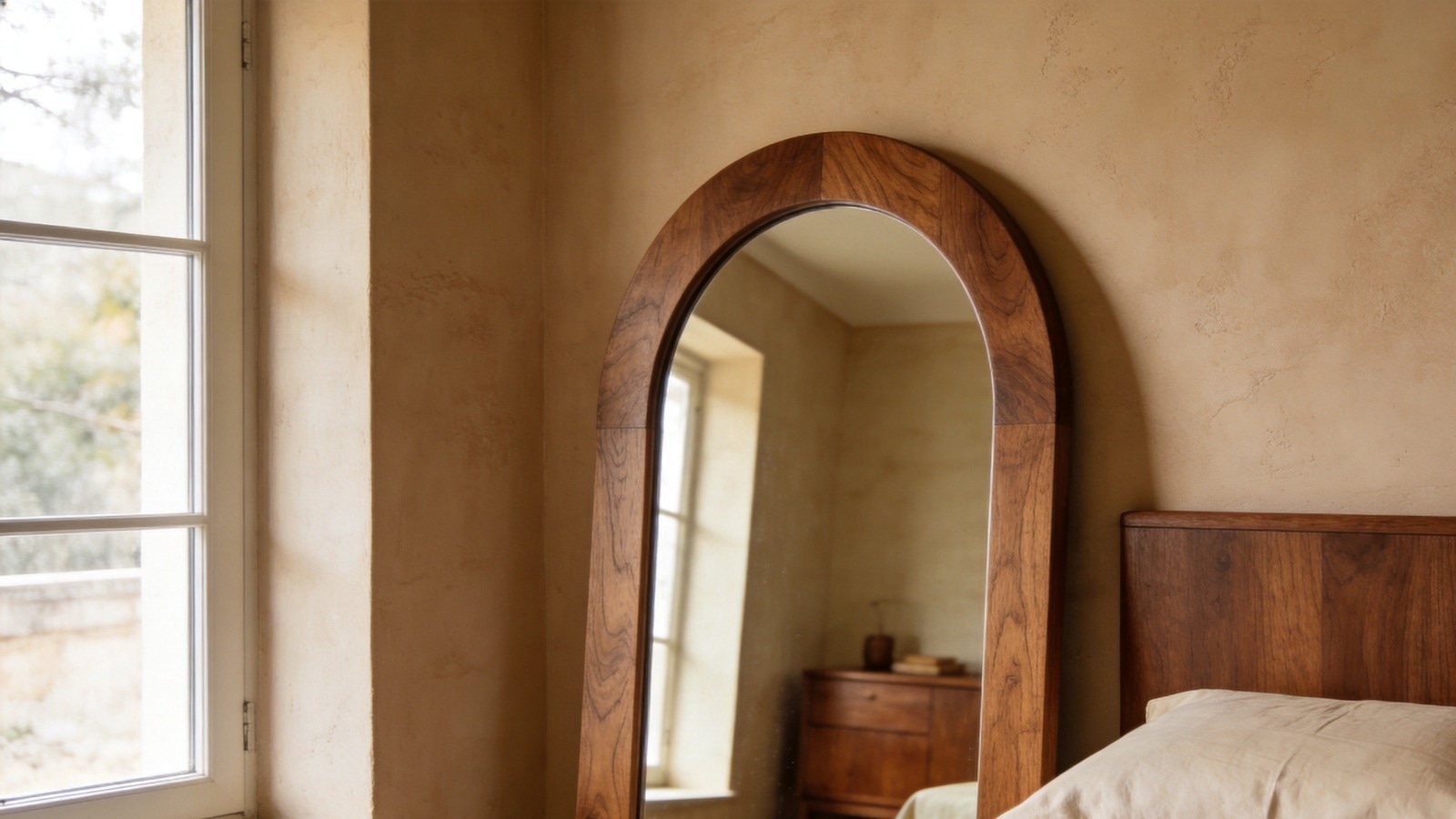
How is a miroir de chambre judged from the bed?
Bedrooms are viewed from a distance and the wall is crowded — proportion and placement dominate over technical correctness.
A miroir de chambre is the most personal item in most furniture orders, and the one buyers under-specify most often. Two reasons.
First, bedrooms are viewed from a distance. You sit on the bed, or you walk past the doorway. You don't stand 400 mm away inspecting the bevel.
That means proportion and placement dominate, and a mirror that is technically correct but hung 150 mm too low will feel wrong for years.
Second, the bedroom wall is crowded. Wardrobe doors, curtains, bedside lighting, sometimes a radiator.
A full-length mirror needs swing clearance in front of it — you have to be able to stand back far enough to see your shoes. We've seen beautiful mirrors installed facing a bed three feet away.
Perfectly made. Useless.
Three things we ask on every bedroom brief:
- Viewing distance. How far back can a person actually stand?
- The anchor point. Over a dresser, beside a wardrobe, or freestanding?
- Pair or single. If two matching mirrors flank a bed, they must be a true pair — same batch, same edge, same orientation. That's a production note, not a shipping note.
Where does an asymmetrical mirror earn its wall?
In rooms with an awkward offset, a sloped ceiling, a chimney breast, or a doorway that refuses to sit in the middle.
An asymmetrical mirror is not a broken symmetric one. It's a deliberate design decision, and it solves a specific problem.
But it carries three practical consequences that should be on the buyer's radar before signing off.
One: the shape has to be drawn, not described. "Organic asymmetric" means something different to every designer.
A traced outline at 1:10 scale, with the two longest dimensions and the narrowest point marked, removes the argument entirely.
Two: the narrow end is the fragile end. Where the form tapers, handling and crating need attention that a rectangle never asks for. We plan packaging around the thinnest section, not the widest.
Three: pairs must be mirrored, not copied. If the design calls for two asymmetrical mirrors — either side of a bed, say — the second one should be the mirror image of the first, not a duplicate.
A duplicate will look like a mistake from the doorway. Say "mirrored pair" on the drawing or you may get two of the same hand.
Get those three right and asymmetry becomes a feature buyers reorder. Get them wrong and it becomes a claim.
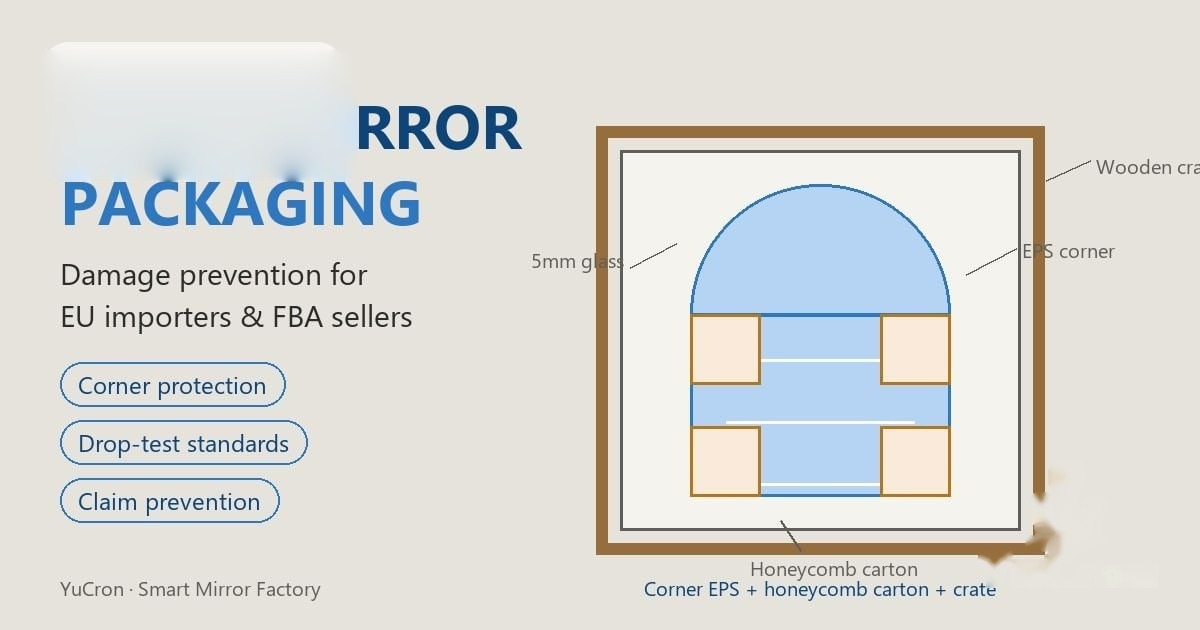
How does length change the crating and the quote?
Length has a cost that has nothing to do with glass — corner protection, edge protection and internal blocking all scale with the long dimension.
A 2,200 mm mirror doesn't ship in the same crate format as a 900 mm one, and it can't be stacked the same way.
| What changes | Tall panel | Wide panel |
|---|---|---|
| Handling | Vertical lift, tipped onto a trolley at the door | Flat carry, doorway width checked first |
| Crating | Long-edge corner protection, vertical blocking | Different unit count per crate, full-width edge protection |
| Quote impact | Destination ceiling height, lift access | Pallet acceptability, store-delivered or container-only |
Rather than guess, we send buyers a simple question set with the quote: destination country, whether pallets are acceptable, and whether the goods will be store-delivered or container-only.
Those three answers shape the packing plan more than anything else on the drawing.
For reference on our side: minimum order is 50 pieces, production runs 15–25 days, and CE and ETL certification are both available for shipments into Europe and North America.
OEM and ODM work is standard — many of the asymmetric and long-format designs we produce started as a buyer's sketch on a single page.
What does a brief that saves everyone a week contain?
Seven lines — a wall photo with a tape measure, mounting intent, viewing distance, a traced outline, pairing, destination and certification.
- A photo of the wall, floor to ceiling, with a tape measure visible
- The intended mounting method — leaning or anchored — if you know it
- Viewing distance, roughly
- A traced outline for any non-rectangular shape, with dimensions at the extremes
- Whether items must ship as mirrored pairs
- Destination country and delivery type
- Certification requirements, if the project needs them
Seven lines. It replaces about eleven emails. And it gives the factory a fighting chance to flag a problem while the glass is still on the rack, not after it's in a crate.
常见问题 → FAQ
Can an asymmetrical mirror be produced in a mirrored pair?
Yes, and it should be specified as a pair on the drawing. The second piece is the reverse of the first, not a copy. If the drawing shows one shape, confirm pairing in writing before production starts.
What is the minimum order for custom long mirrors?
Our minimum is 50 pieces per run, with OEM and ODM supported. Lead time is typically 15–25 days. Both CE and ETL certification can be arranged for European and North American shipments.
Why does a leaning mirror need a strap or floor stop?
Because length turns a small tilt into a toppling risk. A leaning mirror of any real length needs something stopping it from going over, and that hardware changes the back of the product. Ask for it to be shown on the drawing, not assumed.
How do I specify height so the mirror does not read short in the room?
Photograph the wall floor to ceiling with a tape measure in the frame. Mark the baseboard, outlets and light switch. Available wall height is the first number on our intake sheet — catalogue lengths come second.
What does espejos grandes actually specify?
Nothing on its own — it can mean tall, wide, or a wall set, and each is a different order. We ask which one the buyer means before quoting, then confirm the wall photo and the viewing distance before anything is drawn.
Author: Yucron Content Team | Company: YuCron (驭辰科技), Shahe, Hebei, China Last updated: 2026-10-25 Data sources: YuCron company profile, certifications list and manufacturing capabilities pages (yucron.com, accessed 2026-10). Scope note: Commercial terms (MOQ 50, 15–25 day lead time) reflect YuCron's published terms as of October 2026. Confirm current terms in each quotation.
Related Yucron Products
- arched dressing mirror for bedrooms
- 3-way full-length mirror
- Reference note: Tall anchored mirror panels are glazing products under US rules — see 16 CFR 1201 (view)