Wall Mirror Mounting: Adhesive vs Anchored Safety
Nine out of ten mirror enquiries we open start with a phrase, not a drawing. One buyer types wall mirror. Another types espejo adhesivo. A retailer in Stockholm writes spegel. A hotel contractor asks for a round wall mirror with a brushed ring. Four phrases, one object — and underneath all of them sit the same three questions: what holds it up, what it hangs against, and who walks past it every day.
Get those right and size, edge work, framing and certification tend to fall into line. Skip them and a flawless sample still comes back.
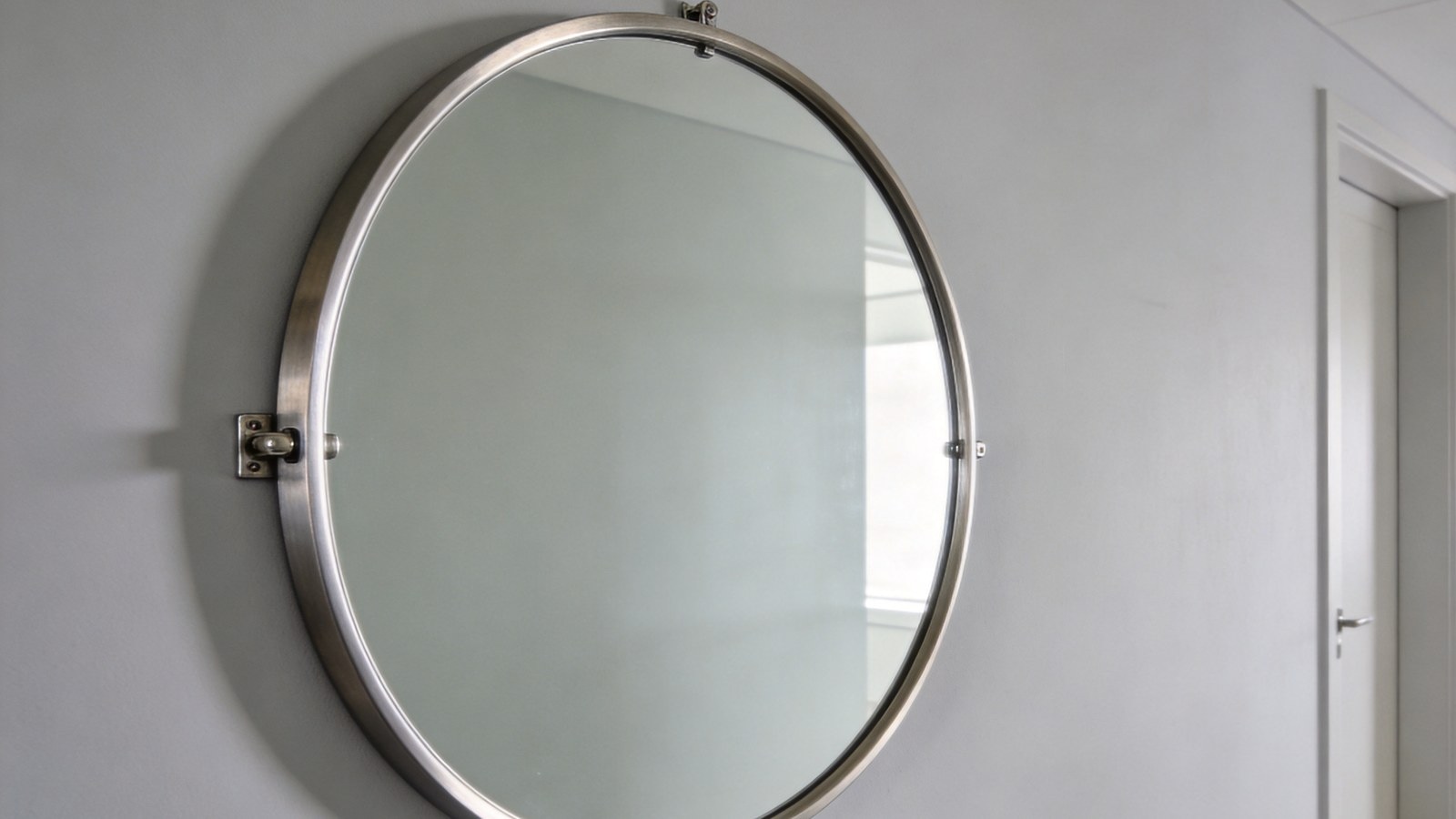
Why is the search phrase not a specification?
Search terms describe a habit, not a product — that is the first thing to untangle.
A wall mirror enquiry could be a decorative panel for a hallway, a lit bathroom mirror for a hotel refurbishment, or a makeup mirror on a countertop. The phrase leaves all of that open.
Round wall mirror closes one door immediately: the shape is already decided, which pushes the conversation toward diameter, edge treatment and where the centre point lands on the wall.
Espejo adhesivo arrives carrying an intention rather than a product: nobody wants holes in the wall.
And spegel is just the Swedish noun — it tells you the paperwork will be in Swedish and the destination is likely European. It tells you nothing about the glass.
| What arrives in the inbox | What it usually signals | The question that follows |
|---|---|---|
| wall mirror | Format still open; decor, project or retail | Mounting method and wall type |
| round wall mirror | Shape locked; often a vanity or corridor piece | Diameter, edge finish, frame ring joint |
| espejo adhesivo | Drill-free intent; renters, small bathrooms | Surface flatness, humidity, panel weight |
| spegel | Nordic-language buyer, European destination | Units, documents, CE marking |
None of those four phrases mentions thickness, backing, edge polishing or certification. So our first reply rarely quotes a price. It asks questions.
What can the wall carry before the buyer picks a finish?
Surface, moisture, temperature and weight — in that order, and all four before aesthetics.
Start with the surface. Glazed tile is flat and non-porous, which is friendly to adhesive. Painted plasterboard is flat until it is not.
Textured plaster, deep grout lines, flaking paint and uneven render are where bonds break, because the contact area is smaller than it looks on a drawing.
Then consider moisture. A bathroom, a spa, a pool changing room: three rooms that punish a weak edge seal.
Then temperature — an unheated hallway or a wall that takes direct afternoon sun will move, and glass does not.
Weight matters more than most first-time buyers expect. Glass is heavy per square metre, and that figure climbs fast as panels get bigger and thicker.
A small panel on a good wall is one conversation. A large panel above a basin, where people lean and splash, is a different one.
It is usually the case where installers want a mechanical fixing in addition to anything adhesive. That is not us being difficult.
A mirror that lets go is a serious hazard, and it is worth asking your supplier what safety backing and edge retention they build in.
Three quick checks before you pick a mounting method:
- Is the wall flat, sound and dry?
- Does the room see steam, spray or wide temperature swings?
- Will the panel be within easy reach, or high up and hard to re-fix?
If any answer makes you hesitate, drill. Concealed fixings exist for a reason.
Why is a round mirror a shape decision rather than a style one?
Because a circle exposes its edge along the whole perimeter — the finish is on show from every angle.
Buyers often treat a round wall mirror as a rectangular one with the corners cut off. It is not.
Polished, bevelled, frameless or framed with a metal ring: whatever you choose, the joint in that ring has to be tight, because a seam on a curve is far more visible than a seam on a straight run.
Frames get bent or rolled rather than mitred, and where the join sits — top, bottom or behind — is a decision someone has to make.
Then there is reflecting area. A 600 mm circle covers noticeably less surface than a 600 mm square. Buyers comparing "the same size" in two formats are not comparing the same thing.
Two practical points we raise early. First, mounting: a single hook lets a round mirror rotate out of level over time, so two fixing points hold it far better.
Those points sit hidden behind the glass, which makes adjustment fiddly. Second, packing: a circle inside a carton leaves void at the corners.
That void is where protection goes, and it changes freight cost per piece compared with a rectangle.
Where do round mirrors sell? Bathroom vanities, powder rooms, hotel corridors, salon and makeup stations, fitting rooms. Aesthetics vary by channel; the geometry does not.
What does espejo adhesivo actually ask for?
A wall conversation, not a tape conversation — the failures are installation problems, not glass problems.
This search phrase has grown for obvious reasons. Renters cannot drill, landlords do not want holes, and small bathrooms have awkward walls.
The failures we hear about follow a pattern: dust or grease left on the surface, a cold room at installation time, weight loaded before the bond has cured.
Add a curved or textured wall, or a mirror too heavy for the adhesive area behind it, and the bond never had a chance.
Every one of those is an installation problem, not a glass problem, which is why we ask about the wall before we talk about the mirror.
Here is the part buyers find surprising: espejo adhesivo is a mounting method, not a product category. Behind the tape there is still a mirror, and it still has a spec.
Frameless glass, an acrylic-backed decorative panel, a framed piece with a hanging rail — three different weights, three risk profiles, three shipping decisions.
On our own line, mounting method is simply one field on the spec sheet, sitting next to shape, size, edge and destination.
If someone genuinely needs a large panel with no holes in the wall, that is a conversation about substrate, weight and safety backing. Not about which tape is strongest.
Why does the paperwork change with the language?
Because spegel, espejo and wall mirror describe the same object in three buying contexts.
Translation traps catch people out. Spegel is the Swedish word for mirror — not a format, a finish or a mounting system.
What actually changes when a Nordic buyer writes spegel is the paperwork: units, document language, destination and the conformity route.
Electrical mirrors heading for Europe carry CE marking; for the United States and Canada, the route is ETL.
Same factory, same glass line, different compliance file. The language also shifts how a brief is written.
Some buyers send a mood board. Some send a competitor photo with a red circle on it. Some send a full drawing. All three are workable, but the third moves fastest.
If you are sourcing under an OEM or ODM arrangement, we would rather see your logo placement, packaging direction and any market-specific labelling in the first message than after tooling.
A first message that gets a fast quote:
- Shape and dimensions, with units stated clearly
- Mounting intent: drilled, adhesive, or both
- Wall material and how humid the room is
- Whether the mirror carries lighting or touch functions
- Destination country, so CE or ETL is settled early
- Quantity — our minimum production run is 50 pieces
- Target date — standard lead time runs 15–25 days
- Existing design, or one to be developed
Eight lines. That is usually the difference between a quote in a day and a week of back-and-forth.
Where do certification and lead time actually land?
Certification shapes the components, and the clock is kinder when the spec is frozen before it starts.
If a mirror has electrical parts, the paperwork shapes the components, the wiring and the testing, and redoing it late is expensive. Decide the market first, then the mirror.
Our production window is 15–25 days, and shape changes, mounting changes and logo changes made mid-run are what stretch a project — not the factory's speed.
Order 50 pieces or 1,000, the same rule applies: the clearer the brief at the front, the fewer surprises at the back.
We ship into North America and Europe, and the two routes behave differently enough that it pays to say which one you are on before anything else.
常见问题 → FAQ
Can a wall mirror be installed without drilling?
Sometimes. Smaller, lighter panels on a flat, sound, non-porous wall are the realistic case for adhesive mounting. Large panels, humid rooms and textured surfaces are where we recommend a mechanical fixing as well. Ask about safety backing too — glass that releases from a wall is a genuine hazard.
Is an espejo adhesivo a different product from a wall mirror?
No. The phrase describes how the mirror meets the wall, not what the mirror is. The glass, edge finish, backing and dimensions are still the spec, and they still determine weight, shipping and risk.
What does spegel mean on a mirror enquiry?
It is Swedish for mirror. Practically, it signals a Nordic-language buyer and a European destination, which affects documents, units and conformity marking. The physical product does not change.
Is a round wall mirror harder to make than a rectangular one?
Different rather than harder. A circle needs consistent edge work around the full perimeter, a frame ring needs a clean joint, and packing leaves more empty corner space. Quotes compare fairly when thickness, edge and backing match.
What is your minimum order and lead time?
Our minimum run is 50 pieces, with a standard lead time of 15–25 days. We support both OEM and ODM work and ship to North America and Europe, with CE or ETL certification depending on destination.
Author: Yucron Content Team | Company: YuCron (驭辰科技), Shahe, Hebei, China Last updated: 2026-10-25 Data sources: YuCron company profile, certifications list and manufacturing capabilities pages (yucron.com, accessed 2026-10). Scope note: Commercial terms (MOQ 50, 15–25 day lead time) reflect YuCron's published terms as of October 2026. Confirm current terms in each quotation.
Related Yucron Guides
- wave full-length LED wall mirror
- decorative mirror tolerances guide
- Reference note: The US safety-glazing baseline for mirror panels is 16 CFR 1201 (view)