Where Each Mirror Style Belongs: Room-by-Room
Four phrases show up in our inbox more than any others: mirror vintage, decorative mirror, eye mirror and wall mirrors home decor luxury. Two are style words, one is a shape word, and the last is an attempt to describe an entire market in five words. None of them is a specification — yet every one ends up on somebody's purchase order.
This guide is about that gap: where each term belongs in a room, and what it costs when the term stays vague until the last email before production.

Why do these four words need different briefs?
Two are style words, one is a shape word, and one describes a market — none of them is a specification.
Getting this straight early saves weeks later.
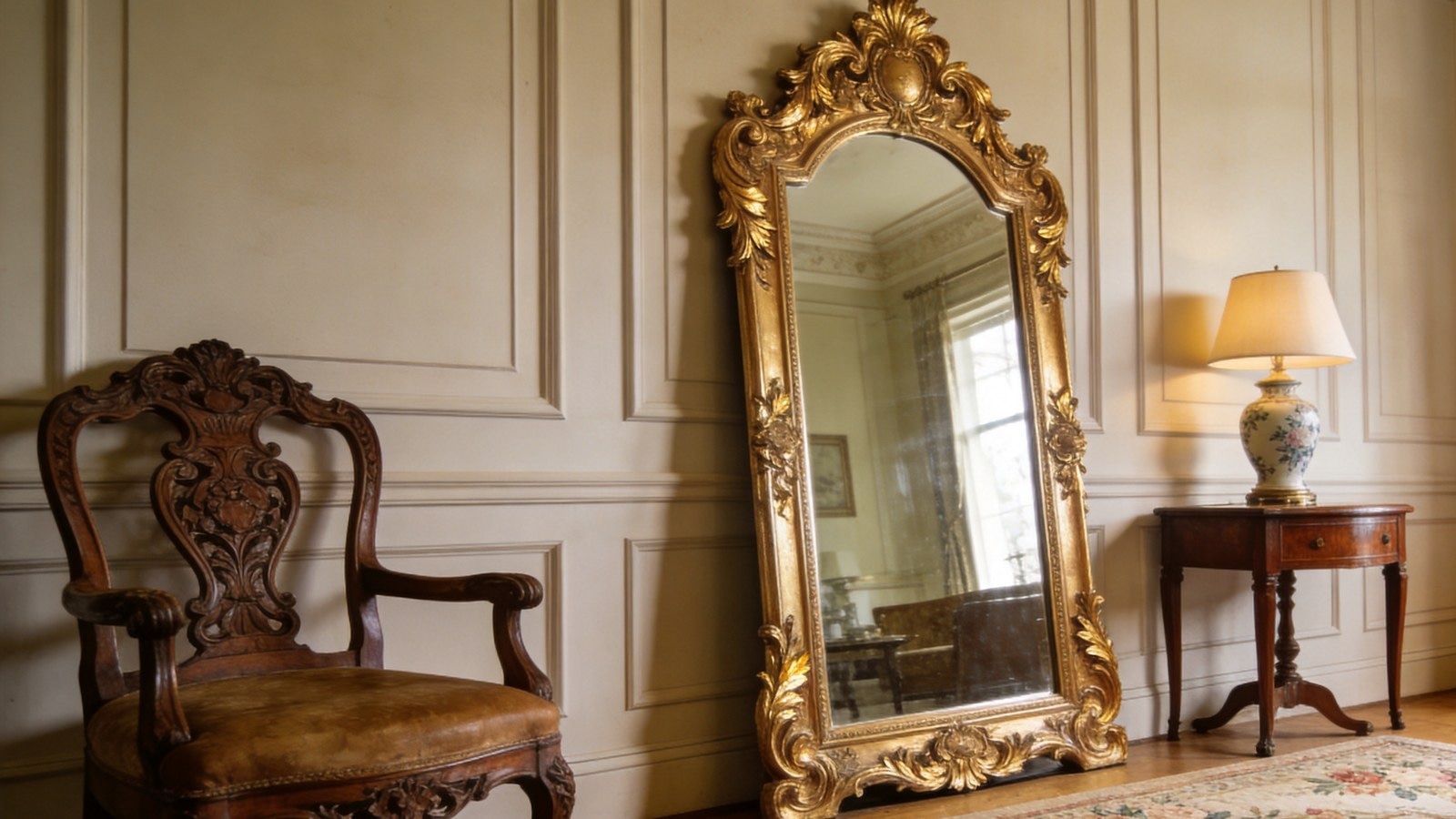
Mirror vintage is a finish conversation. When a buyer writes "vintage," they almost never mean the mirror was made decades ago. They mean it should read as though it has history.
That could be an arched silhouette, a warm metal tone on the frame, or glass with a soft, slightly hazy character. Any of those could be what they pictured — and they cost very differently.
We have received briefs where the entire design direction was three words: "vintage feel, please." That is the beginning of a brief, not a brief.
The useful follow-up isn't "what do you mean?" It's "which of these references is closest?" Buyers are much better at pointing than at describing.
Decorative mirror is a category, not a design. It has the widest search volume and the weakest intent. Retailers use it to build collection pages, designers use it when they haven't decided yet.
It covers an eye mirror, a six-foot leaning panel, a small brass-framed piece by a bedside, and everything between. When a brief says "decorative," a factory has to ask three things:
- Where does it hang?
- Who installs it?
- Is there electricity involved?
Those three answers do more to determine cost than the word "decorative" ever will.
Eye mirror is a shape word with a social-media accent. It is a specific silhouette — an almond or lens outline, sometimes strongly framed, sometimes nearly frameless.
It blew up because it photographs well, and it keeps selling because it flatters a face at close range. Most briefs start as a screenshot from a phone.
An irregular outline is harder to crate than a rectangle. Corners and curves take different protection, and buyers find that out in the claims folder, not the quote.
Luxury is a promise you have to keep in the box. Search the phrase and you get an aesthetic. Order one and you get tolerances, a finish, a mounting method, a carton spec and a paperwork trail.
Luxury in this trade isn't a price point. It's consistency — the hundredth piece matching the first, the box surviving a transatlantic lane, the certificate matching what customs expects.
Where does each style earn its place in the home?
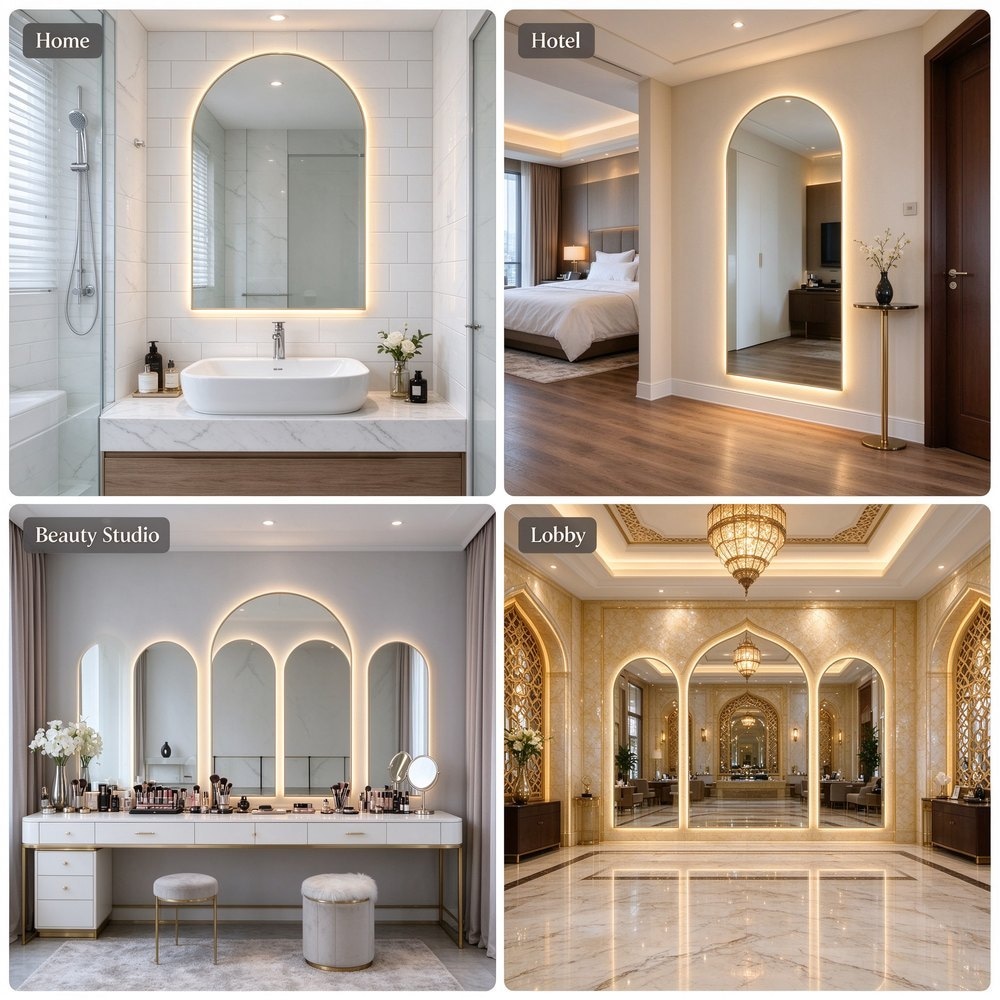
A home decor program rarely needs one mirror — it needs four, in four rooms, and the specs differ every time.
| Room | Dominant term | What drives the spec |
|---|---|---|
| Entry and hallway | Decorative mirror | Proportion to the opposite wall |
| Bathroom | LED smart mirror | Certification and electrical route |
| Vanity corner | Eye mirror | Close-range shape and lighting |
| Hotel suite | Custom repeat silhouette | Tolerance across the run |
Entry and hallway. This is where a decorative mirror does the most work. It is the first thing a visitor sees, and it usually sits opposite something worth reflecting — a door, a window, a stairwell.
Size and proportion matter more here than finish. Get the proportion wrong and no frame saves it.
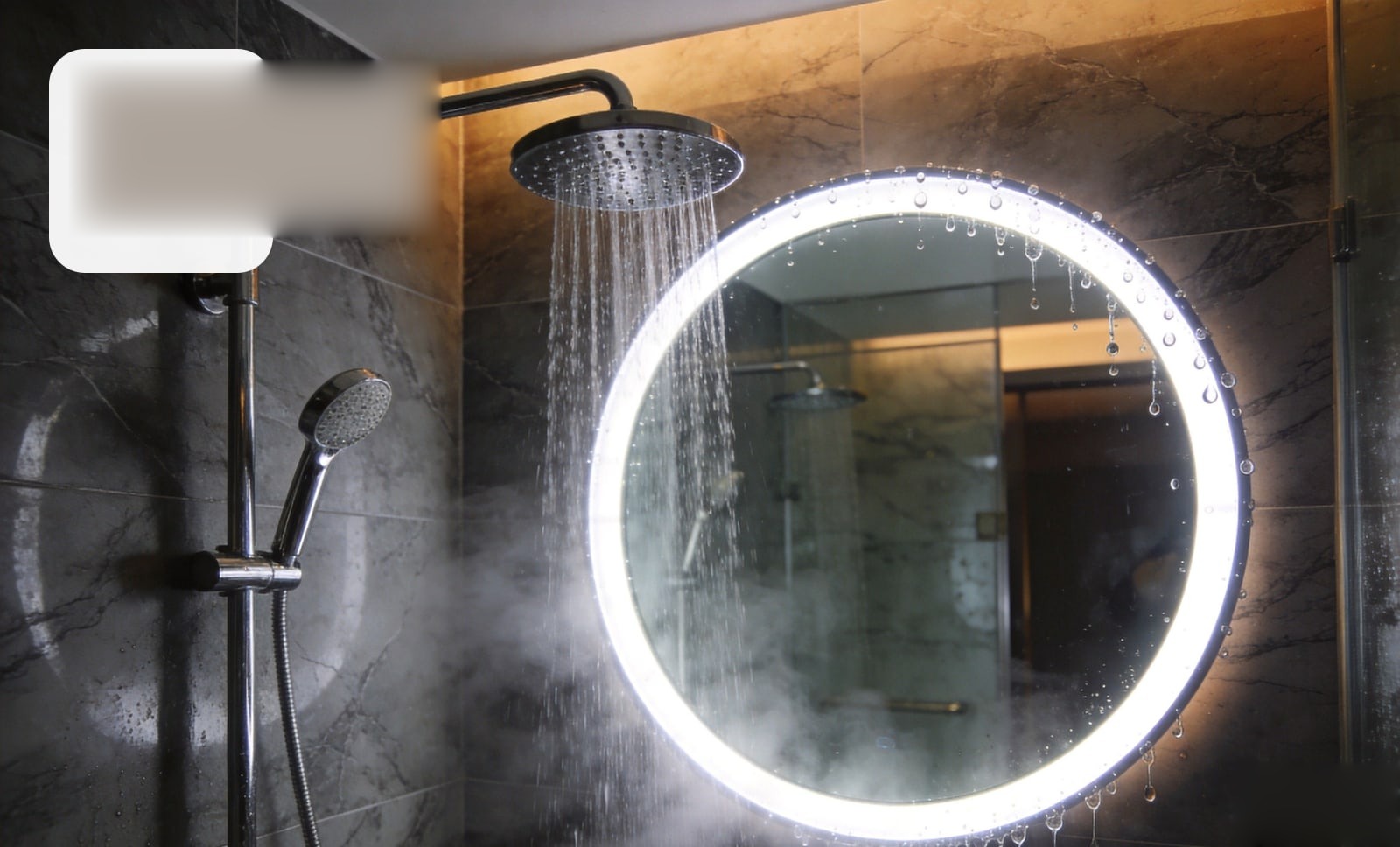
Bathroom — the electrical room. Different category entirely. Once light is built into the product, the conversation changes from aesthetics to compliance.
For North America that means ETL; for Europe, CE. A mirror without electrics is a furnishing. A mirror with electrics is an electrical product, and it gets treated like one at the border.
Buyers who plan a luxury wall mirror program across an entire home often forget this split. The bathroom piece needs a longer runway than the bedroom piece, purely because of certification paperwork.
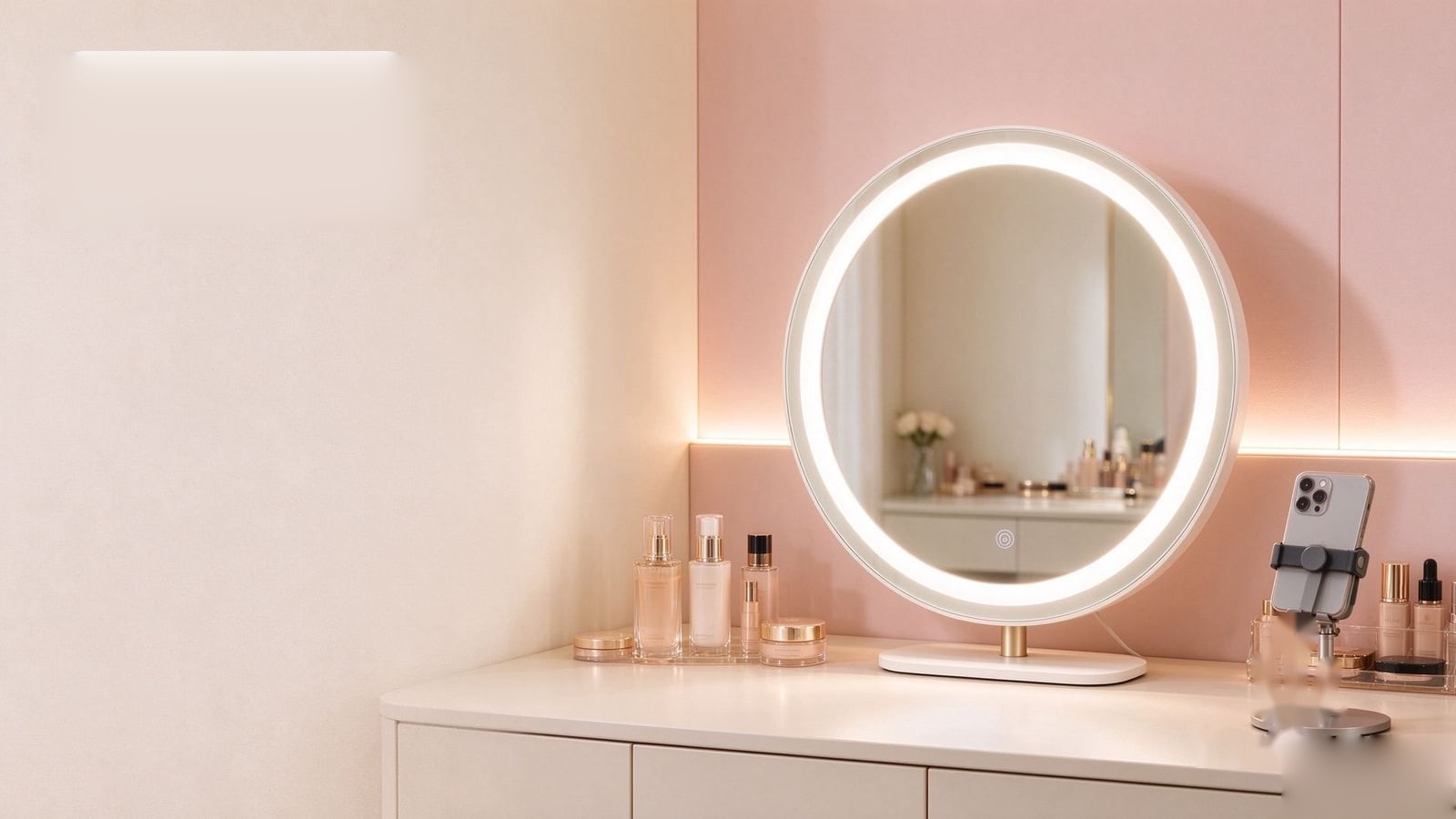
Vanity corner — where the eye mirror lands. Close-range viewing, good lighting, a shape that reads as intentional rather than accidental.
It is also the item most likely to be bought in mixed quantities — a handful of statement pieces alongside a larger run of simpler mirrors.
Hotel rooms and suites. The same silhouette repeats across dozens or hundreds of rooms, so small variances stop being small. A tolerance that is invisible on one mirror is very visible on the fortieth.
This is the category where "luxury" is really tested, because guests compare rooms to each other without ever meaning to.
What has to be locked before anything else moves?
Volume, certification and timeline — in that order.
Volume. Our minimum order is 50 pieces, per order rather than per style — which matters, because these four terms rarely travel alone.
A buyer might want a small run of eye mirror shapes, a set of vintage-leaning decorative pieces, and a batch of standard wall mirrors.
Blended as one production, it clears the line; split into four separate orders, it doesn't.
Certification. If the mirror has light, power or a heating element, decide the destination market first, not last. North America and Europe are our two main export regions.
Ask early. Retrofitting compliance after tooling is an expensive way to learn.
Timeline. Our standard lead time is 15–25 days. The more useful question is what starts the clock — approval of the sample, receipt of deposit, or artwork sign-off.
Those can be days apart, and on a tight retail window, days are the whole margin.
What does OEM/ODM cover, and where does it stop?
Changing a dimension, a profile or a finish is normal work; adding a new electrical function is a different project.
We work on both OEM and ODM terms, and we are comfortable with a buyer who arrives with a reference image and a target price.
What we are less comfortable with is a buyer who treats "custom" as a synonym for "invent a new product."
Adding a new electrical function, a sensor or a control interface has a different rhythm. Both are possible, but just one of them fits inside a standard 15–25 day window, and it isn't the second.
Which two mistakes show up constantly?
Using style language where a spec belongs, and leaving certification and packaging to the end.
"Luxury," "vintage" and "decorative" are all directions, not instructions. Every one of them needs to be translated into something a line worker can measure or see.
The second is leaving certification and packaging to the end. Both are cheap to plan and expensive to retrofit.
A buyer who mentions their destination market in the first email gets a better quote than one who mentions it after the sample is approved.
None of this is complicated. It just has to happen in order.
常见问题 → FAQ
What does "vintage" actually mean on a mirror order?
It's a look, not an age. In practice it usually points to one of three things: an arched or non-rectangular silhouette, a warmer frame finish, or glass with a softer character. Ask for reference images and confirm which one they mean before quoting, because each carries a different cost.
Can I mix an eye mirror, decorative mirror and vintage wall mirror in one order?
Yes. Our 50-piece minimum applies to the order rather than to each style, so mixed assortments are the normal way buyers reach that number. Each distinct shape adds setup and packaging work, so the earlier those are defined, the cleaner the quote.
Do decorative mirrors need CE or ETL?
It depends on whether electricity is involved. A plain mirror with no light or electronics doesn't carry that requirement. An LED smart bathroom mirror does — ETL for North America, CE for Europe. Confirm the destination market at the enquiry stage.
What is the minimum order and lead time?
50 pieces minimum, with a standard lead time of 15–25 days. Both are starting points rather than fixed rules — a project with unusual shapes or new tooling will need more room, and it is better to find that out during quoting than during production.
Does an eye mirror cost more to pack than a rectangle?
Usually yes, because the outline is irregular. Corners and curves take different protection from a straight edge, so the crating is planned around the narrowest and most fragile section rather than the overall footprint.
Author: Yucron Content Team | Company: YuCron (驭辰科技), Shahe, Hebei, China Last updated: 2026-10-25 Data sources: YuCron company profile, certifications list and manufacturing capabilities pages (yucron.com, accessed 2026-10). Scope note: Commercial terms (MOQ 50, 15–25 day lead time) reflect YuCron's published terms as of October 2026. Confirm current terms in each quotation.
Related Yucron Products
- arched dressing mirror for bedrooms
- gold carved baroque full-length mirror
- decorative mirror tolerances guide
- Reference note: Room-by-room mirror placement has design precedents in the V&A collection (view)