What Decides a Mirror Room Quote: Area & Freight
Five buyers at the same glass rack get five prices. Glass surface, touched edges and crate volume decide the number, never the design mood.

What Decides the Number: Glass Area or Design?
A mirror room is an area problem long before it becomes a design problem. Three walls of glass means twenty-odd square metres that must be cut so seams align, polished on every exposed edge, and backed so the reflection stays true.
The same inquiry arrives from four very different buyers, and each is pricing a different object.
| Buyer | What they are buying | Main cost driver |
|---|---|---|
| Mirror room (designer) | 20+ m² of cut, polished, backed glass | Glass area × touched edges × crate volume |
| Small craft mirrors (retailer) | Frame, finish, hanger, retail box | Handling per piece |
| Espejos decorativos (importer) | Same glass plus language and paperwork | Artwork and compliance documents |
| Ultrafragola-style piece (boutique) | Bespoke outline and tooling | Tooling amortisation |
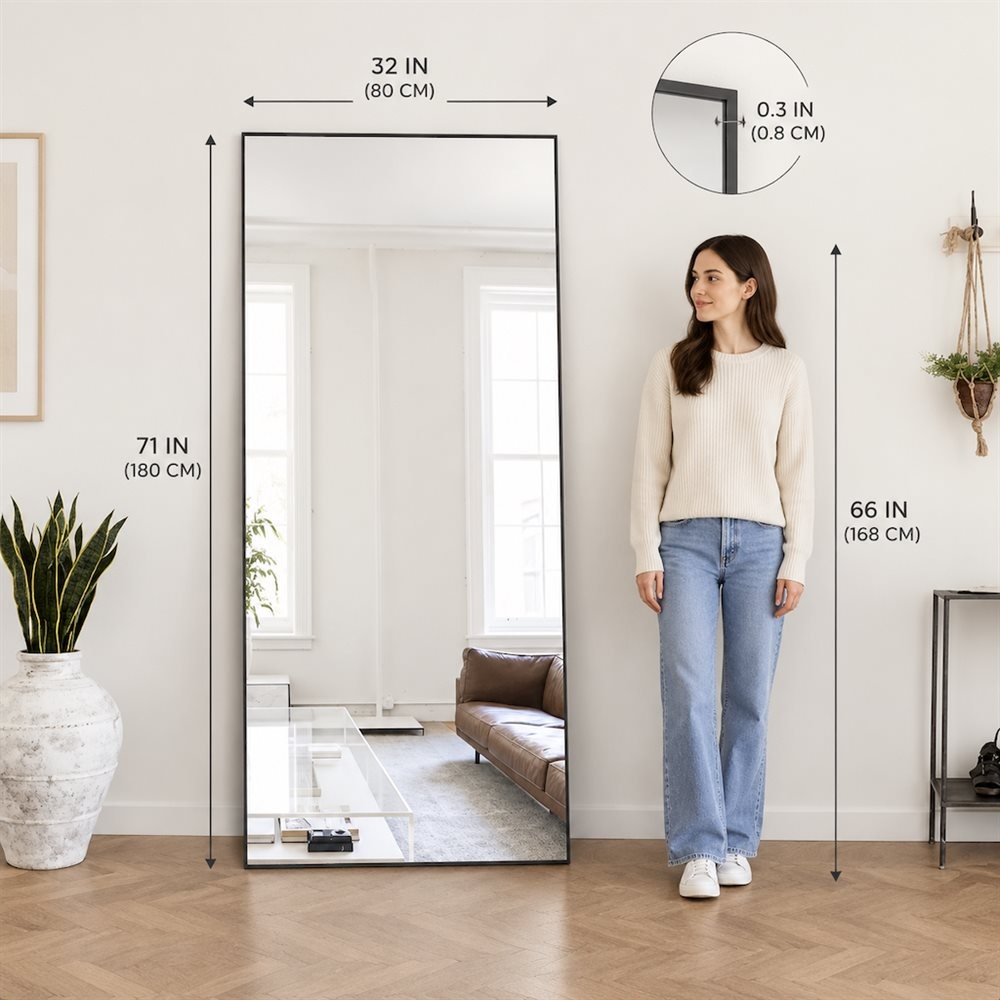
Panels past roughly a metre and a half push thickness, because thin float glass bows and a bowed mirror shows it immediately. Heavier glass means a heavier crate and more freight.
Compare that with a 400 mm decorative round: the glass is a rounding error, and the money sits in frame, finish, hanger and box.
Cost scales with glass area, touched edges and shipped air, not with how good a piece looks.
Can a Mirror Factory Supply Craft-Size Discs?
Search demand for small mirrors for crafts is real: 30 to 60 mm rounds, packs of twenty or fifty, self-adhesive backs.
Here is the honest part. Our line runs decorative, LED bathroom, hotel and makeup models, and craft discs belong to glass cutters.
A retailer asking for five thousand 40 mm discs is asking the wrong factory.
Those emails usually convert into something real: a compact makeup program, a small framed vanity piece, a gift-size mirror with a proper box.
A caution travels with it — a supplier quoting penny craft discs and hotel mirrors is doing one of the two badly.
Are Espejos Decorativos the Same Glass Wrapped Differently?
Buyers in Spain, Mexico and Spanish-speaking US retail type espejos decorativos. It is the same glass cut for English-language decorative orders.
What changes is everything around it: carton language, instruction sheet, how the hanging hardware is described, sometimes the size ladder itself.
Compliance paperwork follows the destination country, not the search language.
Language variants sit comfortably inside OEM and ODM work. One flag: if the Spanish text is not locked when the PO arrives, production waits, because printers need final artwork before the run.
Can a Factory Copy an Ultrafragola Outline Exactly?
Every few months a buyer forwards that wavy, backlit silhouette and asks: can you make this? The honest answer is not exactly.
A wavy profile means glass cut to the outline, edges finished without chipping at the curvature, and a shaped diffuser if there is light behind.
Otherwise the wave narrows into hot spots. Bespoke outlines mean tooling, and tooling pays for itself at volume.
What works is an OEM/ODM adaptation: take the intent — soft irregular outline, warm glow, sculptural mood — and rebuild it as geometry the line can produce at a price that survives retail.
You get the feeling you were chasing. You do not get a one-to-one copy of somebody else's design, and we say that in the first email rather than the fifth.
What MOQ and Lead Time Should You Plan Around?
Two numbers settle most projects: a 50-piece minimum and 15 to 25 days of production.
The clock starts when the sample is approved and the deposit clears, not when the first enquiry lands.
Inside the window sit glass ordering, frame or driver sourcing, assembly, packing approval and final QC.
A brief that changes at day twenty restarts the clock. Freight is separate: add ocean transit, port handling and inland delivery, and buffer the first run specifically.
Which Paperwork Travels With Lit Mirrors?
Mirrors with lighting carry certification questions. The driver, wiring, connectors and labeling all have to be right for documents to mean anything, so the electrical build decides the path.
CE test reports are available on request for European programs, with equivalent documentation for North American runs.
Tell us the destination country in the brief; it changes the bill of materials and the paperwork in the crate.
Non-lit decorative pieces sit in a different bucket: glass safety, edge treatment, packaging integrity and label content. Same factory, different checklist.
Why Does Freight Eat Cheap Panels?
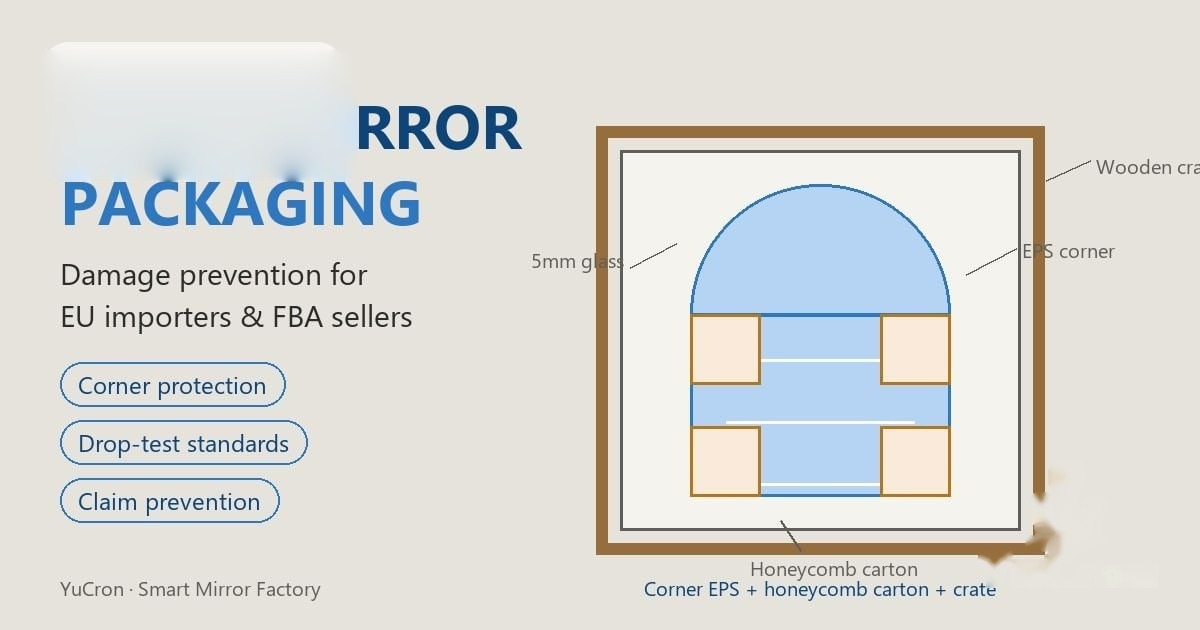
A mirror room order is mostly air: big panels, deep crates, corner protection, foam. You pay to move emptiness across an ocean.
Craft-size packs are the reverse — dense and light but touched by many hands. Retail decor orders sit in between, with retail box, master carton and pallet each adding cost and language requirements.
The takeaway is boring and useful: quote landed, not ex-works. A panel that looks cheap per square metre can lose the advantage entirely inside the crate.
What Eight Items Settle the Quote?
Send these and you get one number instead of three vague ones.
- Destination country, which decides paperwork.
- Lit or unlit, and if lit, color temperature and control.
- Sizes and quantities, broken out per SKU.
- Framed or frameless, and the finish.
- Hanging method: adhesive, anchored, or both.
- Retail packaging or bulk.
- Language for labels, cartons and instructions.
- Reference images, clearly marked as reference rather than specification.
常见问题 → FAQ
What is your minimum order quantity and lead time?
50 pieces per order, with 15 to 25 days in production once the sample is approved. We support both OEM and ODM, so either your drawing or our existing formats can be the starting point.
Do you manufacture small mirrors for crafts?
Not as a line. Our production is built around decorative, LED bathroom, hotel and makeup mirrors at a 50-piece minimum. Craft-scale disc packs come from a different kind of supplier, and those enquiries usually convert into a compact makeup or gift mirror program.
Can you reproduce an ultrafragola mirror exactly?
No, and we say so up front. We can develop a wavy, backlit mirror with similar sculptural character under OEM/ODM, using geometry our tooling and volume can support. An exact copy of a designer piece is a different conversation.
Which documents cover illuminated mirrors for Europe and North America?
CE test reports are available on request for European programs, with equivalent documentation for North American runs. Certification ties to the electrical build of the specific model, so confirm the destination market in the brief.
Can cartons and instructions print in Spanish for espejos decorativos orders?
Yes, OEM and ODM cover label and carton language. We need the final text and artwork before the production run begins, not during it.
Need pricing on any model mentioned? Send models and quantities — unit price, MOQ and lead time within 4 working hours.
Related Yucron Products
- copper-free full-length mirror
- how high to hang an arch mirror above a dresser
- Reference note: Freight survival is what ISTA transit-test protocols are written for (view)