
Turning Room Language into a Mirror Order
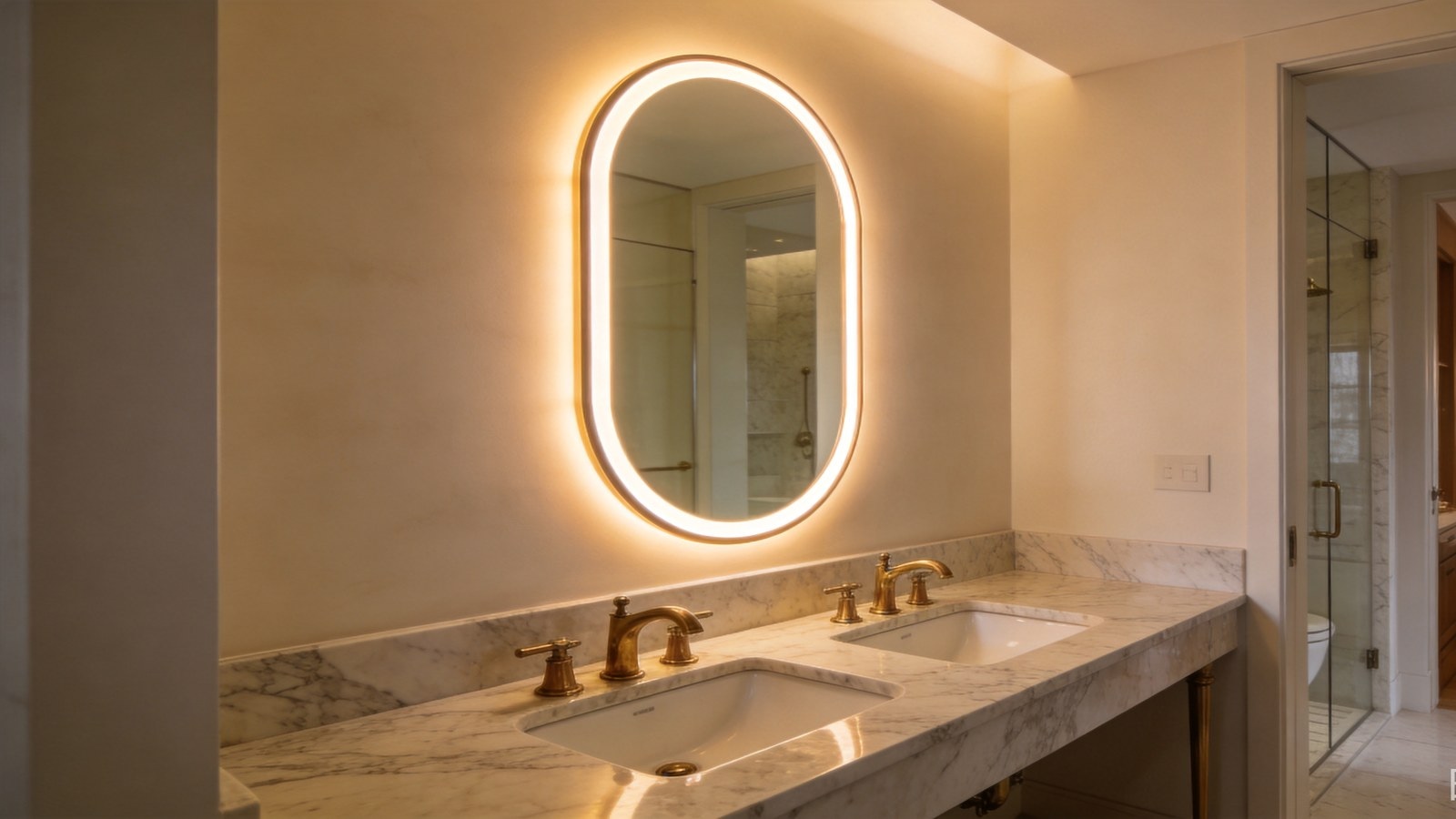
A buyer searching for wall mirror decoration living room ideas usually does not start with a specification sheet. They start with a photo of a sofa wall, a phrase like "something big but not heavy-looking," a Pinterest save of a wooden mirror, or an inquiry with a single word: "specchio." Those first messages are raw material, not a final brief. The factory job is to turn room language into a mirror that can be built, packed, shipped and hung without surprises.
That translation step is what this article is about — and it starts long before anyone talks about dimensions.

Why does the room language come first?
Because the clues are the brief — a good supplier asks for the wall photo, the ceiling height and the furniture line before quoting.
Walk into any living room project and you will hear the same words. "We need a big mirror over the console." "Can the frame be wooden?" "The client sent a specchio reference from an Italian hotel."
None of these is a purchase order yet. They are clues, and a good supplier does not rush past them.
A mirror that reads well in a showroom can look wrong above a low sofa. A big mirror that looks right in a photo can be impossible to anchor on a particular wall.
And a wooden mirror that matches a floor sample under one light can drift under another.
This is why we prefer a short written brief before a sample is approved. Not a long document — one page is often enough.
The buyer writes what the room needs; the factory writes what the build can hold. When those two pages agree, the order moves.
What does "big mirror" really change?
Big is not a size — it is a relationship between the mirror, the wall and the furniture below it.
A big mirror over a long console behaves differently from a big mirror on a narrow chimney breast.
The frame depth matters too: a deep wooden mirror can crowd a small room even when its glass area is modest.
For a living room wall mirror, we look at three things before talking about dimensions:
- The furniture line. The mirror should relate to the console, sofa or cabinet below it, not float alone.
- The walking distance. A mirror seen from two metres away reads differently from one seen from five metres across the room.
- The hanging zone. Studs, plasterboard, brick or a rented wall all change the fixing plan.
A big mirror also changes the shipping math. Glass area drives packing size, and frame depth drives carton volume.
A 50-piece run of large living room mirrors is not the same freight exercise as a 50-piece run of vanity mirrors. Buyers who remember this early avoid a late redesign.
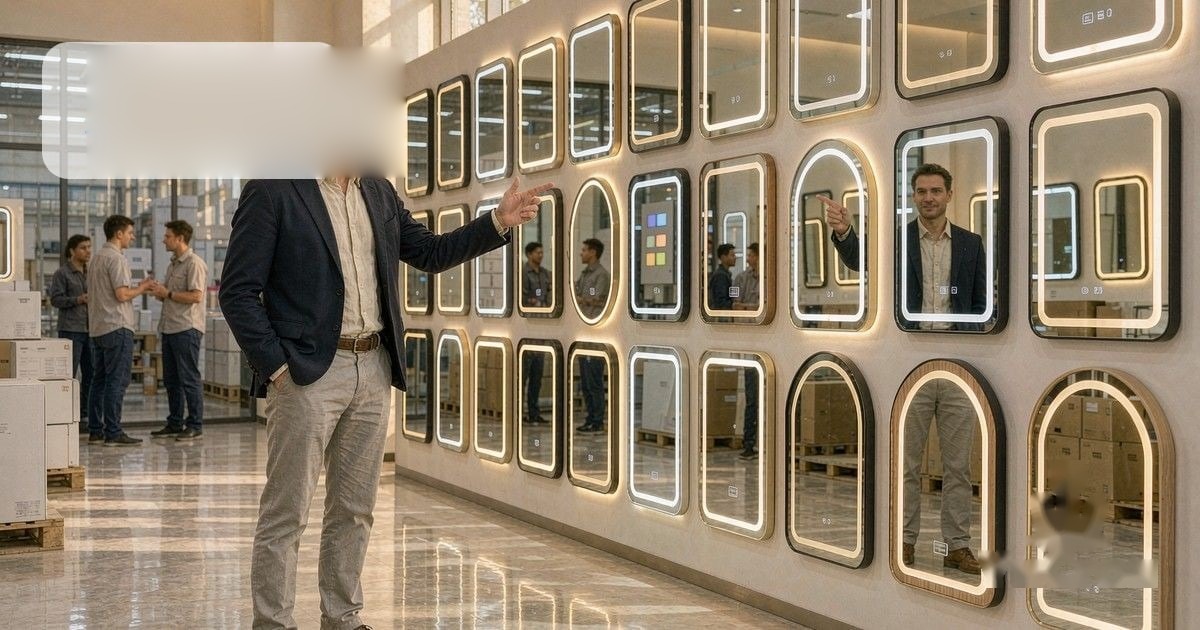
At our factory, a run starts at 50 pieces, and normal lead time is 15–25 days. That window assumes the frame finish, glass spec and packing method are approved before production starts.
If the buyer is still choosing between two wooden finishes on day one, the 15–25 days is not yet real. We would rather say that plainly than promise a date that depends on a decision nobody has made.
Why is a wooden mirror a frame decision first?
Because a wooden mirror is often sold on look, but it should be bought on construction.
The glass is the easy part; the frame is where the order either holds together or starts to move.
Three questions come up again and again. How are the corners joined? How stable is the finish when the room changes temperature? How does the wood sit against the glass without stressing it?
A buyer does not need to write a woodworking thesis, but they do need to approve a physical sample or a clear close-up of the joint. Photos on a screen hide a lot.
There is also the finish-match problem. A wooden mirror for a living room is usually part of a wider scheme: floor, side table, door, maybe a kitchen seen through an opening.
If the frame is meant to match, the buyer should send the reference in real light, not a compressed image. If it is meant to contrast, say so.
"Wooden" alone tells the factory very little. We handle OEM and ODM work, so both paths are open.
One buyer brings a finished drawing and wants it built. Another brings a mood and wants the frame developed.
Both can work — the second path simply needs more sample rounds, and the schedule should reflect that.
Why is "specchio" a language clue?
Because it is the Italian word for mirror — it points at a reference, not a product.
When it appears in an inquiry, it usually means the buyer is working from a European reference, a hotel project, or an Italian design source.
It does not tell you the dimensions, the frame material, the glass or the hanging system.
I have seen a one-line "specchio" email turn into a 20-message thread because nobody asked the basic questions early.
Is it a framed mirror or a frameless panel? Is it for a living room wall or a bathroom? Does it carry light?
If it carries any electrical function, the certification conversation changes.
We work with CE and ETL requirements for the markets that need them, and it is better to settle that before the frame is built.
The same applies to other language slips. A buyer may write "specchio" and mean a full-length mirror, a decorative wall mirror, or a mirror with a wooden frame and an aged finish.
The word is a starting point. The brief has to close the gap.
What should the brief to a mirror factory contain?
One working sheet — not a legal document — that prevents most of the usual back-and-forth.
If you are sourcing a living room wall mirror decoration piece, this is the short version we would put in front of a supplier:
| Brief section | What to send |
|---|---|
| Room and wall | Straight-on and side photo, wall width, furniture width, marked sockets |
| Mirror type | Big, wooden, framed decorative or simple panel; finish direction |
| Frame and edge | Profile, corner detail, edge finish, or a reference photo |
| Hanging and safety | Fixing method and wall condition |
| Market and compliance | Destination, so CE or ETL is settled early |
| Order size and timing | Quantity, target date, sample plan |
Tell the supplier where the product will be sold. We ship to North America and Europe, and the certification path is not identical — do not leave this to the last week.
For order size and timing: a run starts at 50 pieces, lead time is usually 15–25 days, and OEM and ODM are both supported.
If you need a sample first, build that into the plan. A sample is not a delay; it is the cheapest way to find a bad assumption before 50 mirrors are made.
Why is treating the mirror as art the costly mistake?
Because the mistake is rarely taste — it is a late engineering call.
A buyer falls in love with a big mirror image, approves the look, and then asks how it hangs, how it packs, or whether the wooden frame can survive the freight.
By then the schedule is tight and the options are fewer. A living room wall mirror is a decoration piece, yes.
It is also a glass panel with a frame, a fixing system and a carton. Strong sourcing conversations hold both ideas at once.
When they do, the order is quieter. The sample arrives closer to the drawing, the 50-piece run lands with fewer surprises, and the buyer can go back to the room, not the email thread.
常见问题 → FAQ
What does "specchio" mean in a mirror inquiry?
Specchio is Italian for mirror. In a sourcing email, it usually points to a European or Italian design reference, but it does not define the product. Ask for dimensions, frame material, finish, hanging method and destination market before quoting.
How do I choose a big mirror for living room wall decoration?
Start with the furniture line and the wall, not the glass alone. A big mirror should relate to the console or sofa below it and leave enough visual breathing room. Check the hanging zone, frame depth and packing size before you commit to a 50-piece order.
Can you build a wooden mirror from a reference photo?
Yes, through OEM or ODM work. A photo is useful, but the frame joint, finish and edge detail still need approval. A physical sample or a close-up reference is better than a compressed image, especially when the wood has to match other furniture in the room.
What certifications and markets do you support?
We export to North America and Europe. CE and ETL certification are part of the specification where the product and market require them. Tell us the destination early so the compliance path is built into the sample and the production schedule.
What is the minimum order and lead time?
The minimum order is 50 pieces per run, and normal lead time is 15–25 days, assuming the frame finish, glass specification and packing method are approved before production begins. OEM and ODM projects are both supported.
Author: Yucron Content Team | Company: YuCron (驭辰科技), Shahe, Hebei, China Last updated: 2026-10-25 Data sources: YuCron company profile, certifications list and manufacturing capabilities pages (yucron.com, accessed 2026-10). Scope note: Commercial terms (MOQ 50, 15–25 day lead time) reflect YuCron's published terms as of October 2026. Confirm current terms in each quotation.
Related Yucron Products
- wave full-length LED wall mirror
- black arch full-length mirror
- Reference note: Decorative wall mirrors have museum precedents in the V&A mirror collection (view)